 Go Back

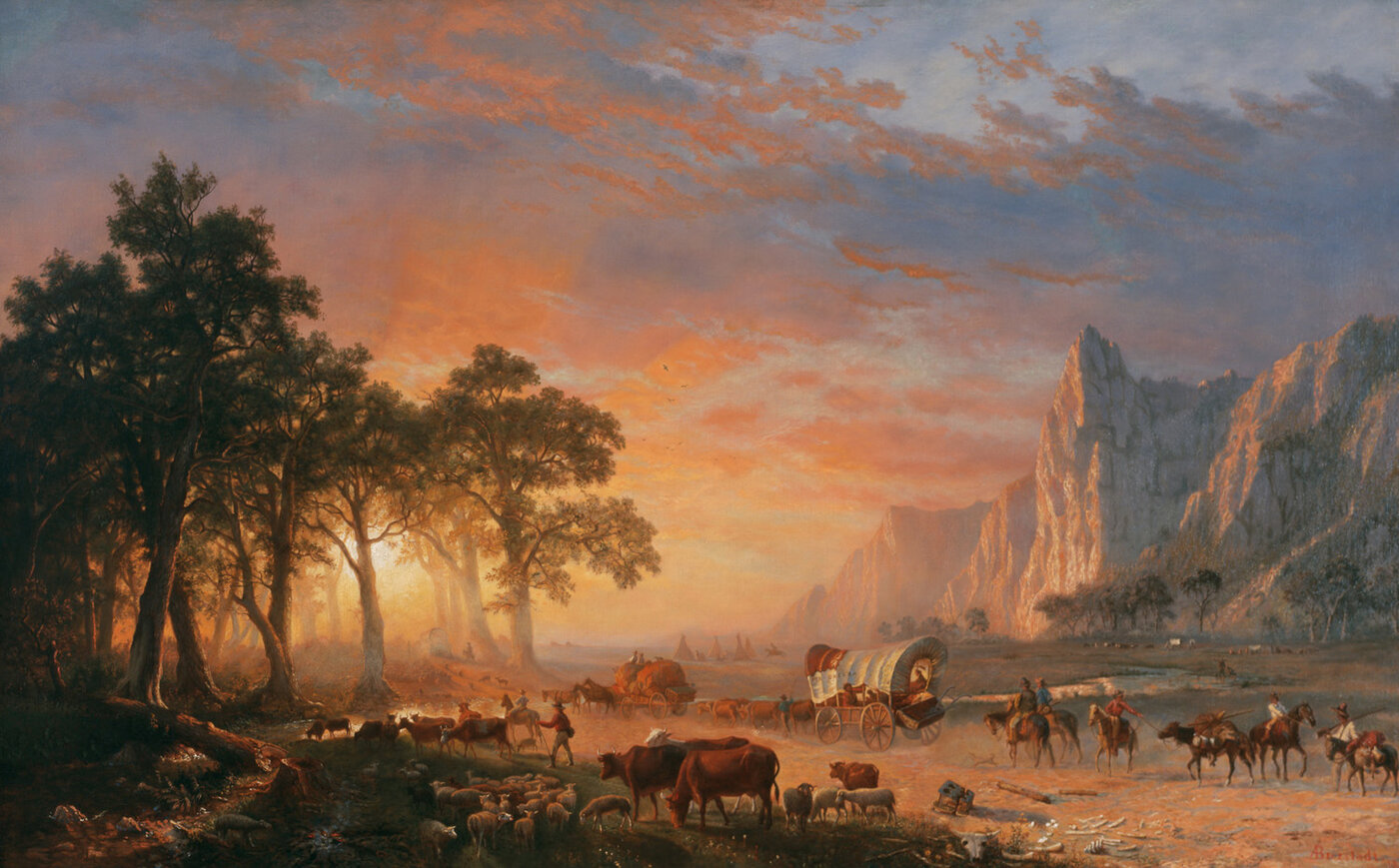
In 1845 the journalist John L. O'Sullivan gave a name to a widespread conviction when he wrote of America's manifest destiny to overspread the continent. The idea mixed genuine beliefs about liberty and opportunity with a claim that the United States was entitled to the lands of Indigenous nations and Mexico. Expansion was already under way: American traders had followed the Santa Fe Trail since the 1820s, fur trappers had mapped the Rockies, and missionaries and settlers were filtering into the Oregon Country, which Britain and the United States occupied jointly. In the 1840s expansion became national policy, driving the annexation of Texas, the war with Mexico, and the partition of Oregon.
The Oregon Trail was the great corridor of that migration. From Independence, Missouri, the trail ran some two thousand miles across the plains, along the Platte River, through South Pass in the Rockies, and down the Snake and Columbia rivers to the Willamette Valley. The first large wagon trains rolled in 1843, and over the following two decades an estimated three hundred thousand emigrants made the journey, walking beside their wagons for five or six months. Cholera killed far more travelers than any other cause, and accidents, exhaustion, and disputes broke many parties; the Donner Party, California-bound emigrants who left the main trail for the Hastings Cutoff and were trapped by snow in the Sierra Nevada in 1846-1847, became the era's most infamous disaster. From 1847, Mormon emigrants followed a parallel route to their new settlement in the Great Salt Lake Valley.
The trails crossed the homelands of the Pawnee, Cheyenne, Lakota, Shoshone, Cayuse, and many other nations, whose economies depended on the buffalo herds and river valleys the emigrants disrupted. Many Indigenous people initially traded with or guided the wagon trains, but the traffic brought disease, depleted game, and mounting conflict. The killing of the missionaries Marcus and Narcissa Whitman by Cayuse warriors in 1847, after a measles epidemic devastated their people, sparked the Cayuse War and hardened demands for military control of the corridor. Treaties such as the 1851 Treaty of Fort Laramie attempted to fix tribal territories and safe passage, but settlement steadily overran the agreements.
By 1846 the Oregon Treaty had divided the region with Britain at the forty-ninth parallel, and Oregon entered the Union as a state in 1859. The overland migration populated the Pacific coast, tightened the bond between East and West, and created the demand for the transcontinental railroad that replaced the wagon trains after 1869. For the Indigenous nations of the plains and Northwest, the trail era opened a generation of dispossession and war, a story continued on the Plains Indian Wars page.
 Britannica: Oregon Trail
 National Park Service: Oregon National Historic Trail
Britannica: Manifest Destiny