 Go Back

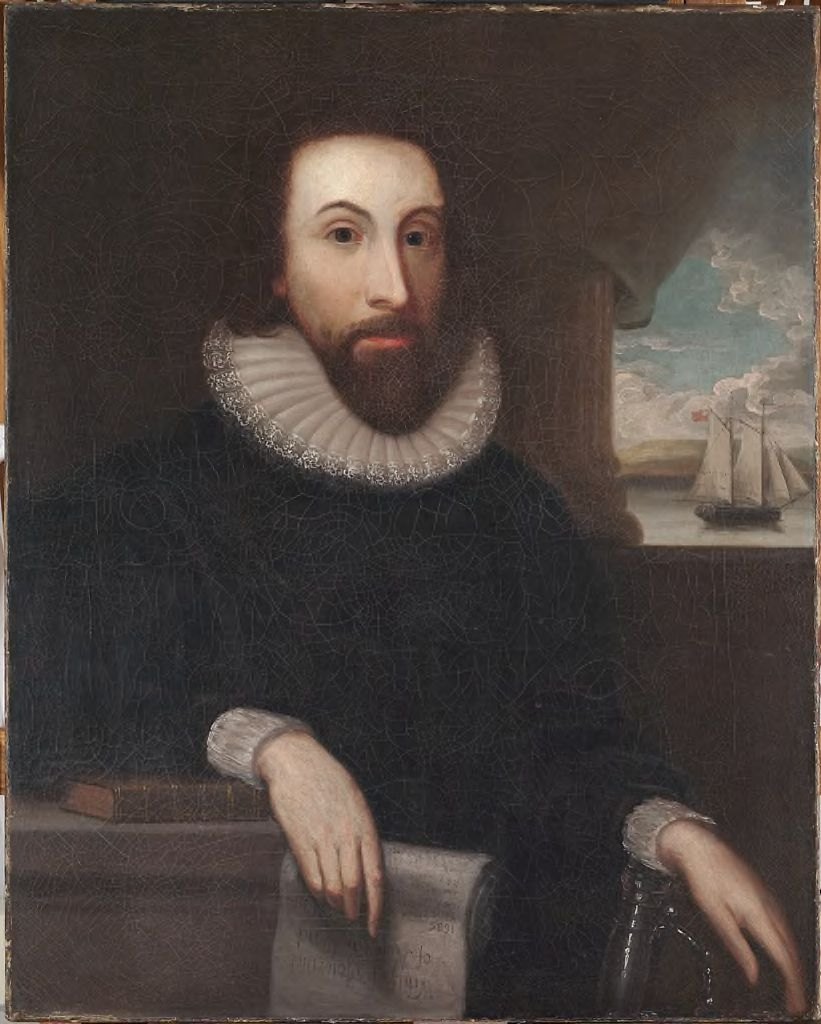
In 1630, a fleet of eleven ships carried about a thousand English Puritans across the Atlantic, the vanguard of a 'Great Migration' that would bring some 20,000 settlers to New England in a decade. Puritans were reformers who believed the Church of England had kept too much of Rome, and under pressure at home they organized the Massachusetts Bay Company, won a royal charter, and, uniquely, carried the charter itself to America, making their colony a largely self-governing commonwealth. Governor John Winthrop preached that their settlement should be 'as a city upon a hill,' a model of a godly society for the world to watch.
Massachusetts Bay was planted as a chain of farming towns, each gathered around its meetinghouse, congregation and common fields. Land was distributed to town proprietors, men were expected to work farms and serve the community, and town meetings managed local affairs with remarkable directness. The colony's leaders built institutions for their vision: Harvard College was founded in 1636 to train ministers, and in 1647 Massachusetts passed the first general public-education law in English America, requiring towns to support schools so that children could read Scripture.
This was also a society of strict boundaries. Voting and office belonged to male church members, and dissent could be dangerous: Roger Williams was banished for challenging the union of church and state and founded Providence in 1636, while Anne Hutchinson's theological challenge to the clergy ended in her exile in 1638. Ministers and magistrates policed doctrine, and the colony's courts enforced religious conformity as a matter of public order.
Puritan confidence also collided with the land's first peoples. English settlement spread into Pequot, Massachusetts and Wampanoag country under pressure of epidemics and land sales, and in 1675-1676 King Philip's War devastated both Native nations and colonial towns. The colony lost its original charter in 1684 and became a royal province in 1691, absorbing Plymouth. Yet the town meeting, the schoolhouse, and the restless habit of building 'a city upon a hill' remained lasting bequests of the Puritan experiment.
 Britannica: Massachusetts Bay Colony
 National Park Service: The Puritans
 Library of Congress: America as a Religious Refuge