 Go Back

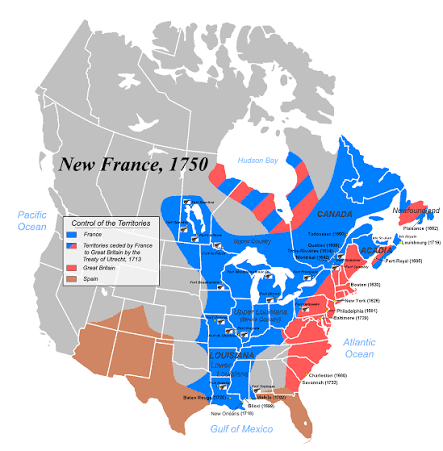
New France. New France was the French colonial empire in North America, claimed for King Francis I when Jacques Cartier entered the Gulf of St. Lawrence in 1534. After an early colony near Quebec failed, the French fur trade with the First Nations took root, and Samuel de Champlain founded Port-Royal, the first French colony in North America, then in 1608 began the settlement of Quebec on a commanding site controlling the narrowing of the St. Lawrence. New France matters because its economy rested on the fur trade and on alliance with Indigenous nations rather than on mass settlement: the Company of New France held a monopoly of the trade in return for bringing settlers, missionaries aimed to convert the First Nations and excluded Huguenots, and vigorous young men slipped away from the seigneurial estates - where habitants farmed land granted by seigneurs in return for dues - to become coureurs de bois in the forests.
Under royal rule the colony pushed far beyond the St. Lawrence: Louis Jolliet explored the Mississippi until he was sure it flowed into the Gulf of Mexico, and in 1699 Pierre Le Moyne d'Iberville founded Louisiana, another part of New France. War with England shadowed the colony from the start - during King William's War a New England fleet under Sir William Phips seized Acadia, though Quebec defied his attack - and in 1700 and 1701 peace was made between the Iroquois and New France. The end came in the Seven Years' War: when peace was made by the Treaty of Paris in 1763, all New France east of the Mississippi, outside the environs of New Orleans, was ceded to Great Britain, and France kept only the two little islands of St. Pierre and Miquelon. French culture, however, survived the conquest - above all in Quebec, and in the Louisiana that passed through Spanish and French hands before ending up with the United States in 1804.
 Britannica: New France
 Smithsonian Institution: New France
 National Geographic: The story of New France: the cradle of modern Canada
 PBS: Empire of the Bay: Setting Sail for North America