 Go Back

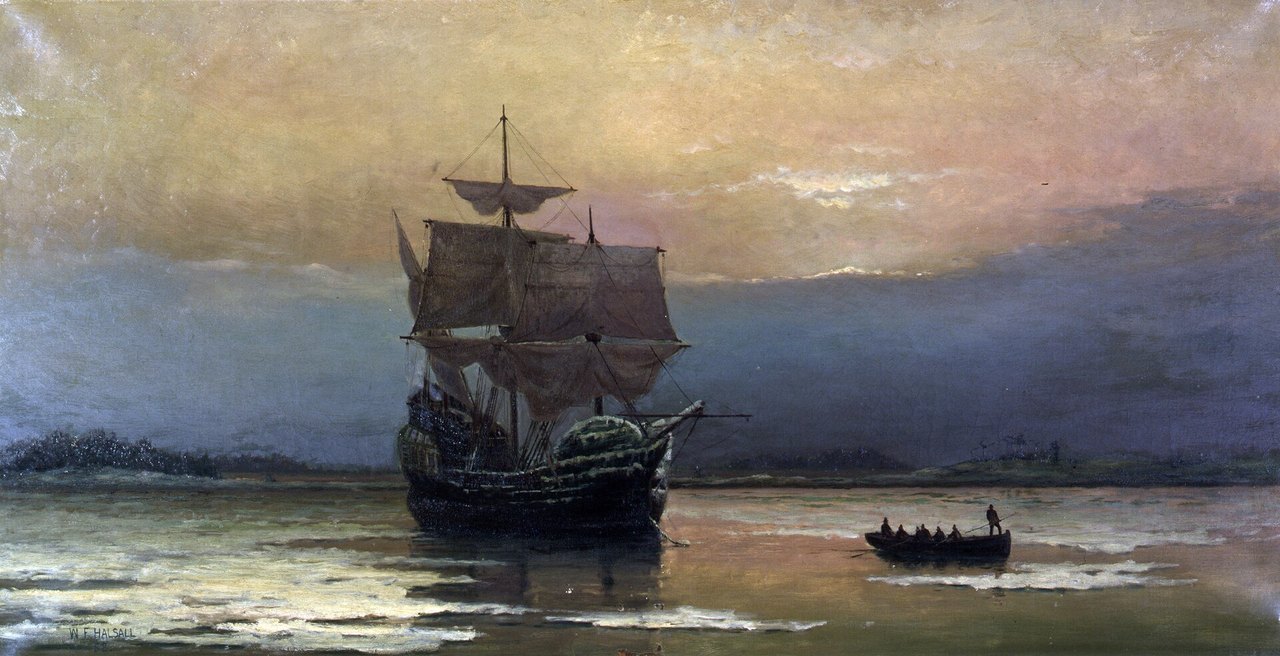
In September 1620 the merchant ship Mayflower left England carrying 102 passengers. About a third were Separatists, religious dissenters who had broken with the Church of England and spent a decade in exile in the Dutch city of Leiden; the rest were 'Strangers,' workers, servants and adventurers sent by the voyage's investors. Blown north of their Hudson River destination, they anchored off Cape Cod. Because their patent did not cover this land, the leading men signed the Mayflower Compact aboard ship, pledging to form a 'civil body politic' bound by majority-agreed laws, a landmark of self-government, before anyone went ashore.
The colonists settled at an abandoned Patuxet village they named Plymouth in December 1620, and the first winter killed half of them. They survived with help that was anything but accidental. Tisquantum, called Squanto, a Patuxet man who had been kidnapped to Europe and found his way home to an emptied land, taught the newcomers to plant corn with fish and navigate local diplomacy. In 1621 the settlers and the neighboring Wampanoag confederacy, led by the sachem Ousamequin (Massasoit), agreed a mutual-defense pact, and that autumn the two communities shared a harvest feast remembered as the first Thanksgiving.
The Wampanoag had reasons of their own for the alliance. Epidemics brought by earlier European ships had killed as many as two-thirds of the coastal peoples between 1616 and 1619, leaving Massasoit's confederacy vulnerable to its Narragansett rivals. The alliance held for fifty years, but the peace depended on Massasoit's personal diplomacy as English numbers swelled from one town to many, steadily swallowing Native land, hunting grounds and authority.
Plymouth Colony itself remained small, pious and self-governing, electing its governors and General Court, until it was absorbed into Massachusetts in 1691. Its larger legacy lies in the patterns it set: a covenant community bound by compact, a holiday built on a real but fragile moment of coexistence, and a warning. When Massasoit's son Metacom, called King Philip, watched the land and power of his people slip away, the unequal partnership collapsed into the terrible war of 1675 that forever changed New England.
 Britannica: Pilgrim Fathers
Britannica: Mayflower Compact
 PBS American Experience: The Pilgrims
 Smithsonian NMAI: Rethinking Thanksgiving Celebrations