 Go Back

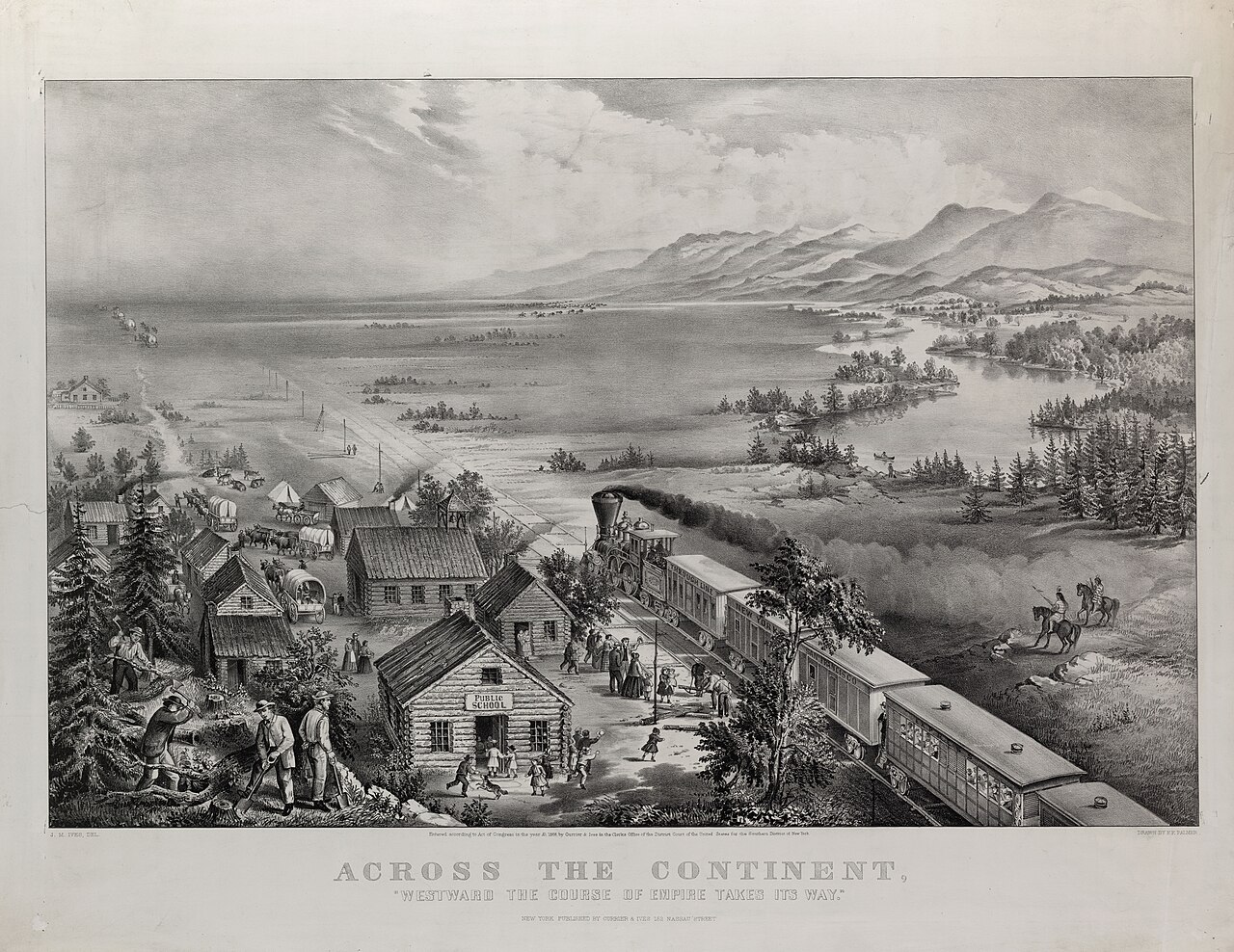
In 1830 the United States had almost no railroads; three decades later tens of thousands of miles of track laced the eastern states. After the Civil War the network burst westward, encouraged by federal land grants. The first transcontinental line, originally called the Pacific Railroad, was built by the Central Pacific eastward from California and the Union Pacific westward from the Missouri River. On May 10, 1869, the two lines met at Promontory, Utah, where a ceremonial golden spike joined the continent, and a journey to the West that had taken months shrank to about two weeks.
Construction was brutal as well as transformative. Crews of Irish, Chinese, and other immigrant workers blasted through mountains and crossed deserts, and towns sprang up along the lines. The tracks ran through Indigenous lands taken by treaty and by force, and the buffalo herds on which Plains peoples depended were hunted to the edge of extinction, hastening the conquest of the West.
Railroads also changed time itself. Every town once set its clocks by the local sun, so schedules crossed scores of slightly different local times, and confusion grew with every mile of track. The problem was felt most sharply in the United States and Canada, where long routes passed through places several hours apart. In 1883 the railroads adopted standard time zones, and in 1884 delegates from several countries met in Washington, D.C., and adopted the Greenwich meridian as the world's prime meridian, establishing the framework on which worldwide time zones were built.
With fast, scheduled, standardized transport, goods, mail, and people moved as never before. Farmers in Kansas sold wheat in New York, mail-order houses shipped goods to remote towns, and factories drew on national supplies of coal, iron, and food. By 1924 the United States had the largest rail network in the world, and the national market it created had helped make the country the world's leading industrial economy.
 Britannica: Transcontinental Railroad
Britannica: Standard Time
Britannica: Railroad