 Go Back

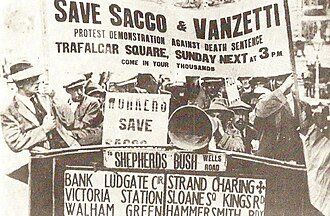
Sacco and Vanzetti. On 15 April 1920, in South Braintree, Massachusetts, two gunmen robbed a shoe factory's payroll and shot dead the paymaster and his guard. Three weeks later police arrested two Italian immigrant laborers: Nicola Sacco, a shoemaker, and Bartolomeo Vanzetti, a fish peddler - both armed, both anarchists, both lying clumsily about their movements, for they believed, not without reason, that they were being hunted as radicals in the year of the great Red Scare.
Their trial, in the spring of 1921 before Judge Webster Thayer in Dedham, became the most disputed verdict in American criminal history. The ballistics evidence was murky and contested; the eyewitnesses contradicted themselves and one another; the prosecution harped on the defendants' anarchism and draft evasion; and Judge Thayer, off the bench, called them 'those anarchist bastards.' The jury convicted both men of murder in July 1921.
Then began six years of appeals, motions and a world-spanning campaign. The case split America and electrified Europe: demonstrations in Paris, London, Buenos Aires, Johannesburg; the greatest writers and jurists of the age - Anatole France, H.G. Wells, Felix Frankfurter - protesting the verdict as a frame-up of foreigners and radicals. Every motion failed; Governor Fuller's advisory committee, headed by Harvard's President Lowell, upheld the verdict; and on 23 August 1927 Sacco and Vanzetti died in the electric chair at Charlestown prison. Vanzetti's last statement made the case immortal: 'I am suffering because I am a radical and indeed I am a radical... I might have lived out my life talking at street corners to scorning men. I might have die, unmarked, unknown, a failure. Now we are not a failure.'
The execution made them martyrs across the world - Dos Passos, Upton Sinclair, Maxwell Anderson wrote it; Ben Shahn painted it; the names became shorthand for American injustice and, to others, for radical myth-making. Fifty years later, on the anniversary in 1977, Governor Michael Dukakis proclaimed their trial unfair. The ballistic argument continues to this day: the truth about South Braintree remains, after a century, unproven either way.
 Britannica: Sacco-Vanzetti Case
Britannica: Bartolomeo Vanzetti