 Go Back

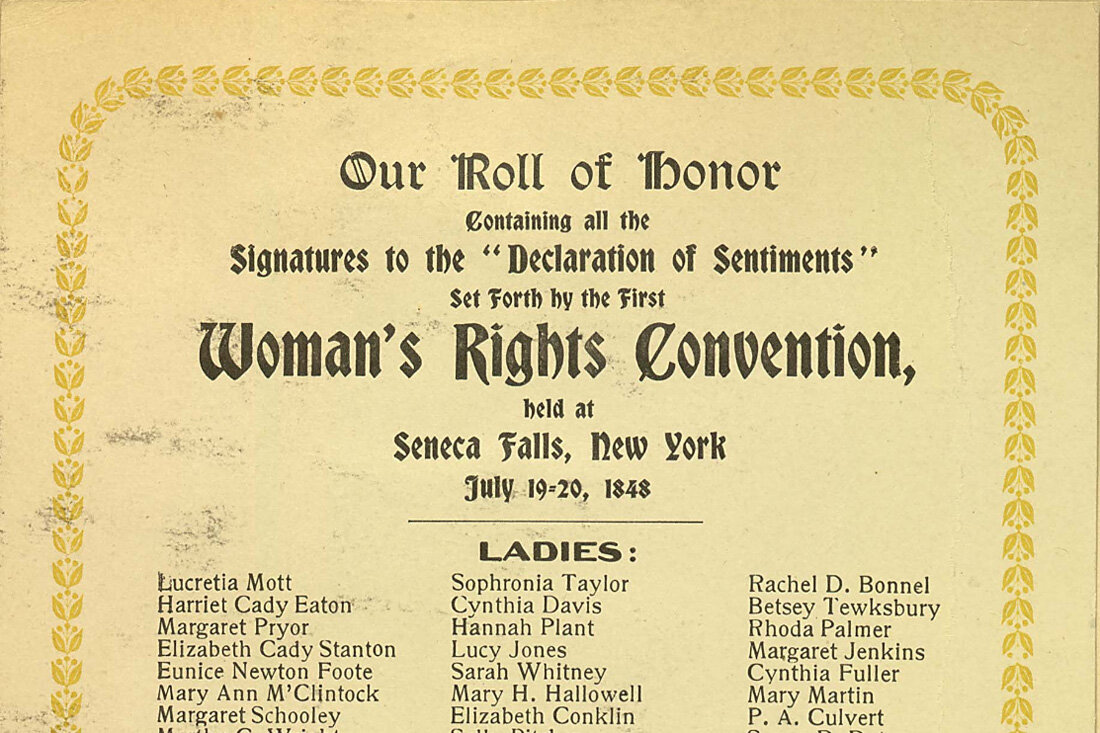
In the early nineteenth century, American women lived under the common-law doctrine of coverture: a married woman's legal identity was absorbed into her husband's. She could not vote, sign contracts, sue, or control her own earnings or property, and colleges and the professions were closed to her. The reform movements of the era opened a crack in that wall. Women did much of the work in temperance, charitable, and antislavery societies, and in doing so they discovered both their own organizing power and the contradiction of demanding freedom for the enslaved while being denied basic rights themselves.
The immediate spark came at the World Anti-Slavery Convention in London in 1840, where the women chosen as American delegates, including Lucretia Mott, were refused seats because of their sex; Elizabeth Cady Stanton, in London with her delegate husband, was likewise allowed only to listen, not to participate. Eight years later the two women organized a convention at the Wesleyan Chapel in Seneca Falls, New York, on July 19-20, 1848. About three hundred people attended, including the abolitionist Frederick Douglass. The convention adopted a Declaration of Sentiments modeled on the Declaration of Independence, listing men's repeated injuries and usurpations toward women. Its most radical resolution, demanding the vote, passed only after Douglass rose to defend it.
Seneca Falls was the beginning, not the whole movement. From 1850, national women's rights conventions met nearly every year, and activists won concrete legal gains, including New York's Married Women's Property Acts of 1848 and 1860, which let wives own property and keep their earnings. New institutions opened: Oberlin had admitted women since 1837, and Mount Holyoke Female Seminary, founded by Mary Lyon in 1837, offered serious higher education. The Civil War suspended the conventions, and the movement split afterward over whether to support the Fifteenth Amendment, which enfranchised Black men but not women.
In 1869 Stanton and Susan B. Anthony formed the National Woman Suffrage Association while rivals founded the American Woman Suffrage Association; the two merged in 1890 as the National American Woman Suffrage Association. Meanwhile the West led: Wyoming Territory granted women the vote in 1869, followed by Utah, Colorado, and Idaho before 1900. Generations of petitioning, state referenda, and organizing finally produced the Nineteenth Amendment, ratified in 1920, which forbade denying the vote on account of sex, seventy-two years after the first resolution at Seneca Falls.
 Britannica: Seneca Falls Convention
 National Park Service: Women's Rights National Historical Park
Britannica: Women's Suffrage