 Go Back

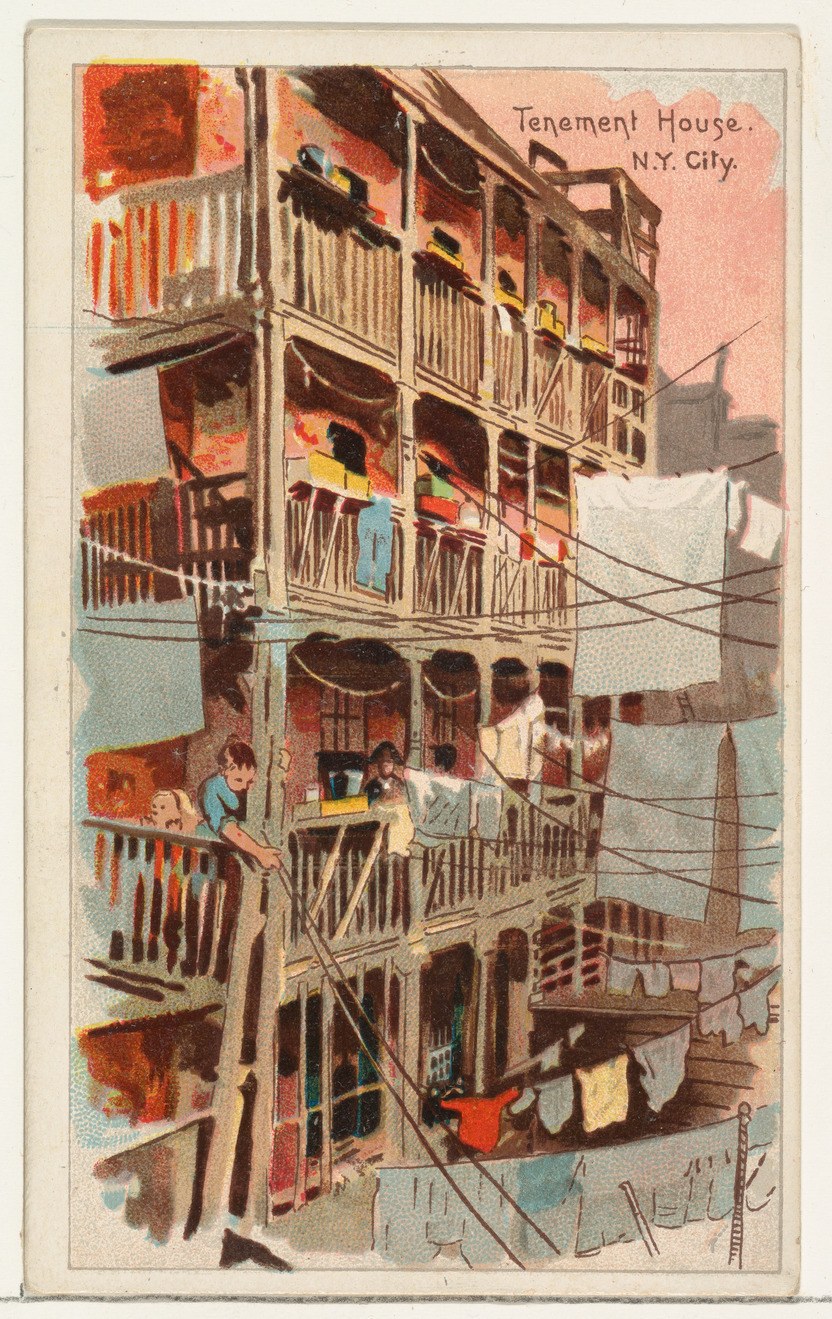
Between 1880 and 1920, millions of immigrants and rural migrants poured into American cities, and nowhere were they packed tighter than in New York's Lower East Side. A tenement was simply a set of rooms rented as a separate dwelling, but in practice the word came to mean narrow apartment houses, first built in New York in the 1830s, whose "railroad flats" lined up rooms one behind another like boxcars, with little light or air. Whole families lived in one or two rooms, privies stood in dark yards, and diseases such as tuberculosis thrived in the crowded, sunless blocks.
Reformers first had to make comfortable Americans see these conditions. Jacob Riis, a Danish-born police reporter assigned to the Lower East Side, used the new technique of flash photography to capture the interiors of slum housing at night. His book How the Other Half Lives (1890), with its pictures of cellar lodgers, of sweatshops where workers earned a few cents a day, and of alleys like Bandits' Roost on Mulberry Street, shocked middle-class readers and made him famous.
The shock produced laws. New York's Tenement House Act of 1895 outlawed the worst rear tenements, and the Tenement House Act of 1901, passed after a state investigation that Riis helped inspire, set new minimum requirements: windows, fire escapes, and better sanitation for every apartment. City health departments meanwhile attacked disease directly by inspecting tenements, purifying water, campaigning for pasteurized milk, and sending nurses into immigrant neighborhoods. Settlement workers and visiting nurses taught hygiene and pressed for public baths, playgrounds, and clean food.
By 1924 the tenement had become a regulated building type rather than a lawless one, and large cities ran public health bureaus that tracked births, deaths, and contagious disease. Overcrowding remained severe, and reformers increasingly argued that policing bad housing was not enough, that government had to help build better housing. Riis's method of combining photographs, statistics, and personal stories to force reform became a lasting model for American investigative journalism.
 Britannica: Jacob Riis
 Wikipedia: How the Other Half Lives
Britannica: Tenement