 Go Back

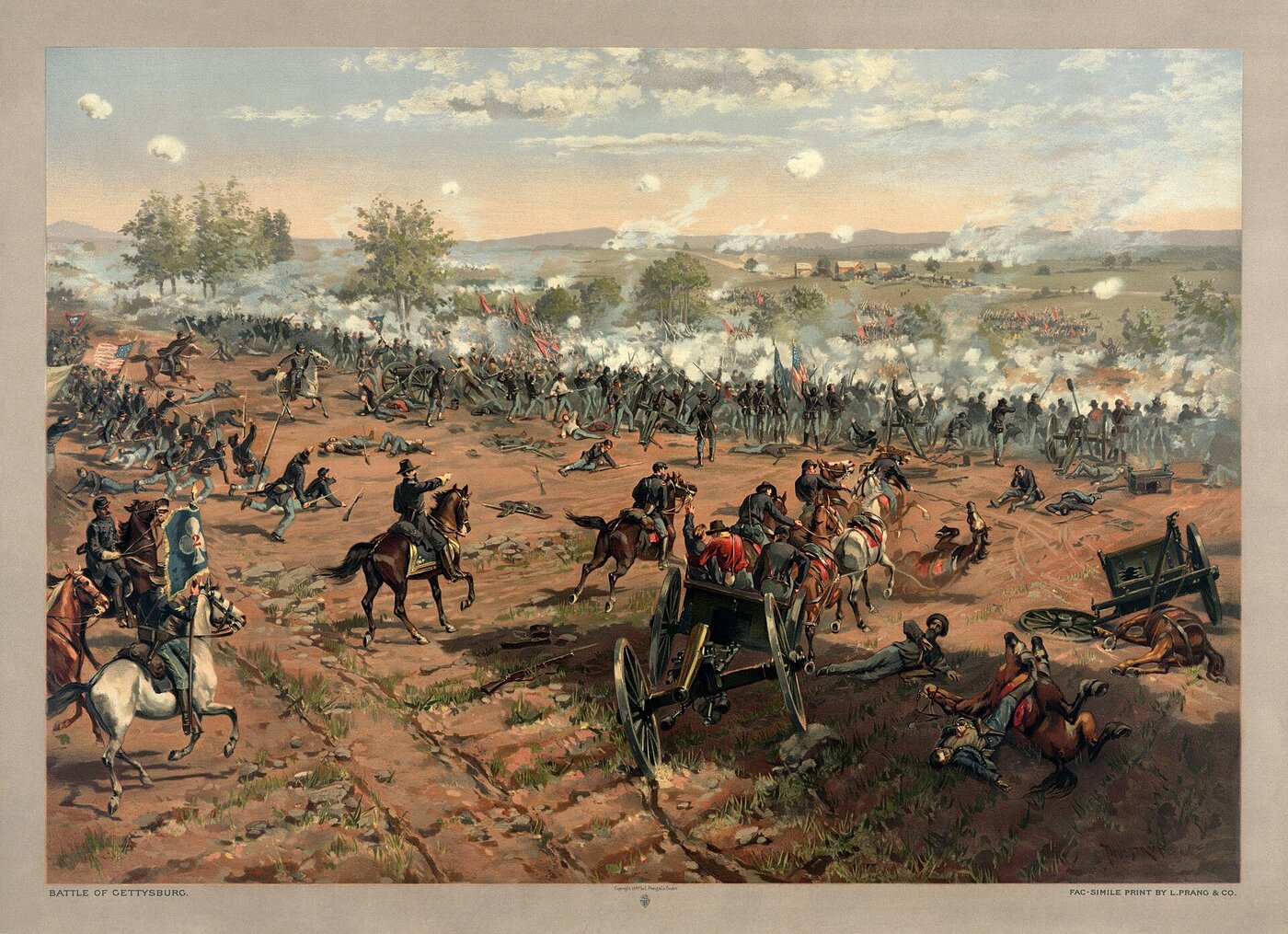
The Civil War grew out of the sectional conflict over slavery's expansion that compromise after compromise had failed to settle. When Abraham Lincoln, pledged to stop slavery's spread, won the presidency in November 1860, South Carolina seceded in December, followed by six more Deep South states that formed the Confederate States of America under President Jefferson Davis. On April 12, 1861, Confederate guns fired on Fort Sumter in Charleston harbor, Lincoln called for seventy-five thousand volunteers to suppress the rebellion, and four more slave states, including Virginia, joined the Confederacy. Both sides expected a short war; both were wrong.
The war in the East became a grinding contest between the Union Army of the Potomac and Robert E. Lee's Army of Northern Virginia. After the Union disaster at First Bull Run in July 1861, a series of cautious Union generals failed to exploit their advantages. Lee repelled George McClellan's drive on Richmond in 1862, invaded the North, and was stopped at Antietam that September, the bloodiest single day in American history. Lee won brilliant victories at Fredericksburg and Chancellorsville, but his second invasion ended at Gettysburg in July 1863, the war's turning point in the East.
In the West, Ulysses S. Grant opened the war's decisive theater. His captures of Forts Henry and Donelson in 1862 split Confederate defenses, and after the terrible battle of Shiloh his army drove south. The surrender of Vicksburg on July 4, 1863, followed by Port Hudson's five days later, gave the Union control of the Mississippi River and cut the Confederacy in two, while a Union naval blockade slowly strangled southern trade. In 1864 Lincoln made Grant general in chief: Grant hammered Lee in Virginia while William T. Sherman took Atlanta and marched across Georgia to the sea, destroying the South's capacity and will to fight. Lee, cornered and starving, surrendered to Grant at Appomattox Court House on April 9, 1865.
The Union won because of its crushing advantages in population, industry, railroads, and finance, because its navy commanded the seas and rivers, because Lincoln's leadership held the northern coalition together, and because emancipation, covered on its own page, turned the war into a fight the Confederacy could not win diplomatically or morally. The war cost some 620,000 soldiers' lives, more than all other American wars combined to that date. It destroyed slavery, settled secession forever, and created a more powerful federal government, leaving the unresolved work of freedom to Reconstruction.
 Britannica: American Civil War
 National Park Service: The Civil War
 Library of Congress: Civil War Glass Negatives Collection