 Go Back

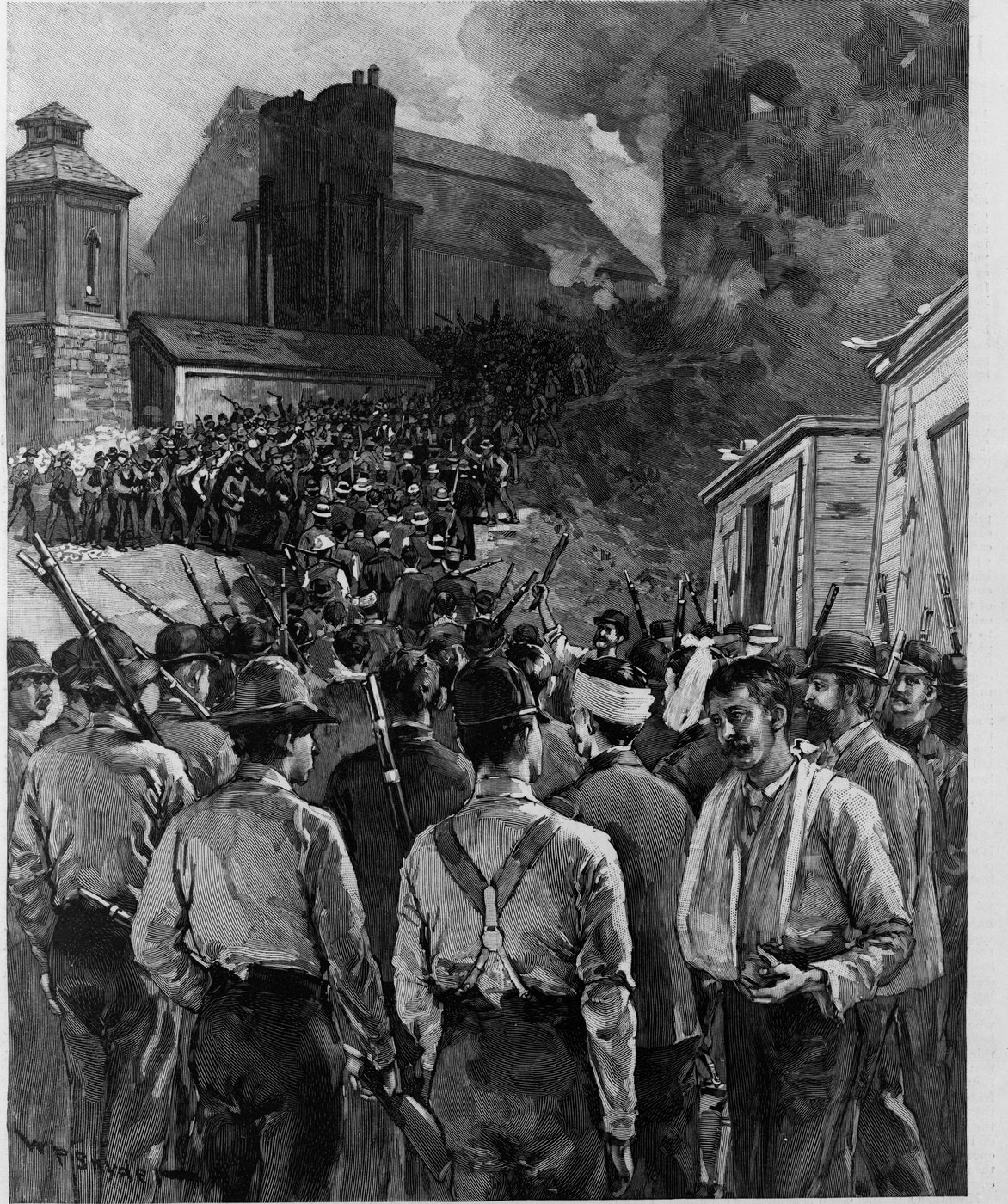
Industrial workers in Gilded Age America faced long hours, subsistence wages, child labor, and machines that maimed thousands every year, with no insurance, no pensions, and courts ready to jail organizers. Their answer was combination. The National Labor Union, founded in 1866, campaigned for the eight-hour day; the Knights of Labor, organized in 1869 and led after 1879 by Terence Powderly, welcomed nearly all producers, skilled and unskilled, men and women, Black and white, into one big union, and swelled to perhaps seven hundred thousand members by 1886. The Knights dreamed of a cooperative commonwealth, but their future was decided in the strike waves of the 1870s and 1880s.
The Great Railroad Strike of 1877 was the first nationwide labor conflict in American history. When the Baltimore and Ohio Railroad cut wages for the second time in a year, workers in West Virginia walked out, and the strike spread along the rail lines to Baltimore, Pittsburgh, Chicago, and St. Louis. State militia killed strikers, crowds burned rail yards, and President Hayes sent federal troops to move the trains. Perhaps a hundred people died before the strike collapsed. It failed, but it announced that labor conflict in industrial America would be national, and often violent.
In May 1886 a nationwide campaign for the eight-hour day ended at Chicago's Haymarket Square, where a bomb thrown at police killed seven officers; eight anarchist leaders were convicted in a trial widely condemned as unjust, and four were hanged. The Knights of Labor, unfairly tarred by the bombing, went into decline, and leadership passed to the American Federation of Labor, founded in 1886 under Samuel Gompers, which organized skilled workers by craft and pursued wages and hours rather than utopia. The 1890s brought the era's bitterest defeats: troops broke the Homestead steel strike against Carnegie in 1892, and in 1894 the government used a court injunction and the army to crush the Pullman boycott led by Eugene V. Debs's American Railway Union.
Labor's fortunes rose slowly after 1900. The AFL grew to millions of members, the mine workers won recognition in the coal fields, and the great strike wave of 1919, followed by the open-shop drive of the 1920s, showed both the movement's reach and its limits. Courts, troops, and hostile law remained labor's constant enemies, but the union idea was permanent, and the eight-hour day, won industry by industry, was written into federal law for railroad workers in 1916.
 Britannica: Great Railroad Strike of 1877
Britannica: Haymarket Affair
Britannica: Pullman Strike