 Go Back

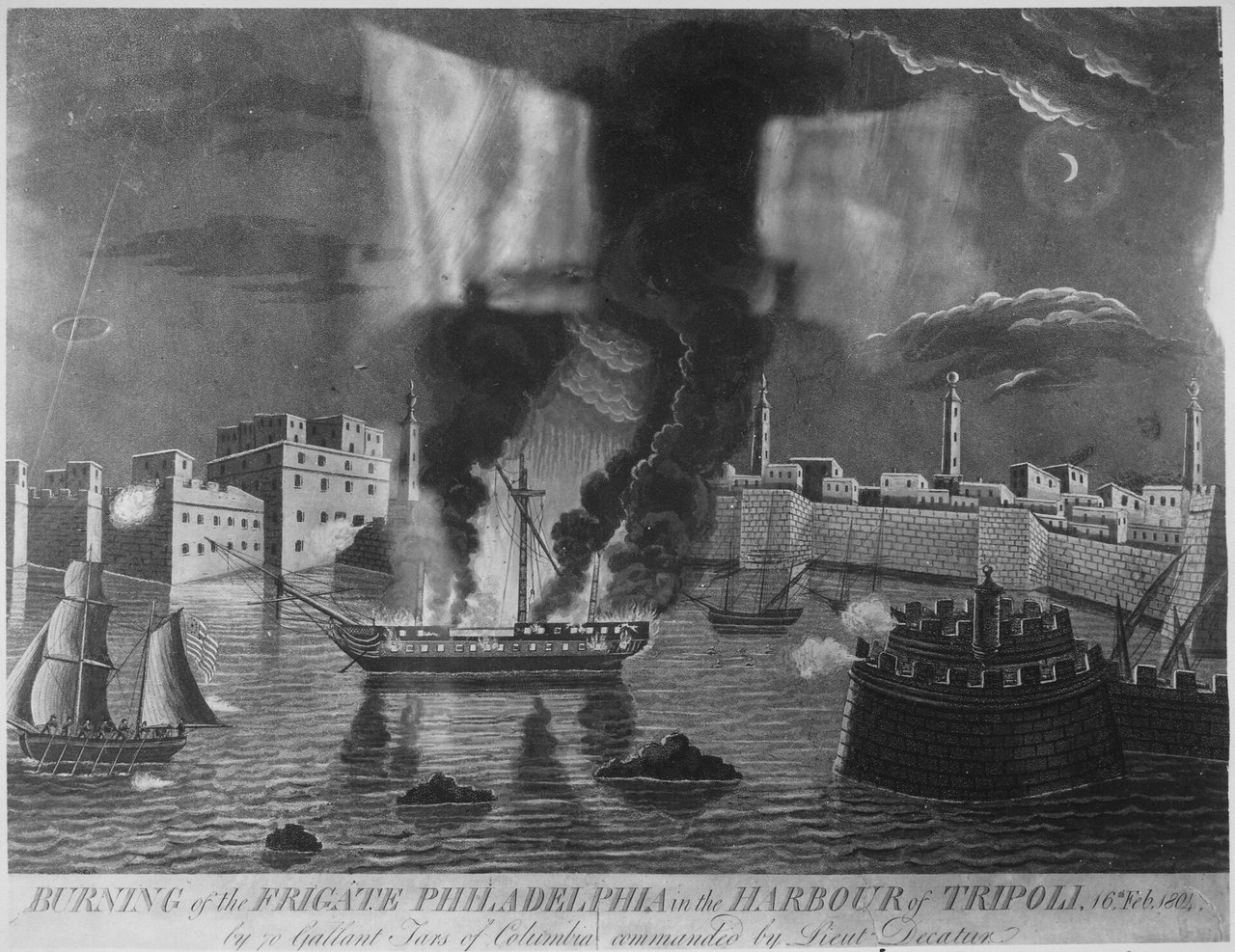
The Barbary Wars. American independence lost American ships their shield: no longer covered by Britain's agreements, their merchantmen in the Mediterranean became prey to the Barbary States - the North African regencies of Algiers, Tunis, Tripoli and Morocco - whose corsairs took ships and crews for ransom and tribute. By the 1790s the United States was paying a fifth of its federal budget in tribute; and in 1801, when Jefferson refused the Pasha of Tripoli's raised demands, the Pasha chopped down the flagstaff of the American consulate - the Barbary declaration of war.
Jefferson, the frugal apostle of small government, answered with the navy. For four years American squadrons blockaded and bombarded Tripoli. The war made its legends: the frigate Philadelphia, grounded and captured in Tripoli harbor in 1803, was boarded and burned in a daring night raid led by Stephen Decatur - 'the most bold and daring act of the age,' Admiral Nelson called it. And in 1805 the consul William Eaton and Lieutenant Presley O'Bannon led a polyglot mercenary column and eight Marines on a five-hundred-mile desert march to storm Derna - 'to the shores of Tripoli,' as the Marines' hymn still sings.
The war ended in 1805 with a treaty that freed the Philadelphia's crew and ended tribute to Tripoli - though ransom was still paid, and Algerine corsairs kept taking American ships until 1815, when Decatur returned with a squadron and dictated peace to Algiers, Tunis and Tripoli in a single summer, ending American tribute to the Barbary States forever.
The Barbary Wars were the young republic's first wars overseas, and they made the United States Navy: its first heroes, its first doctrine - that a republic could and would fight far from home rather than pay - and the Marine Corps' oldest song. 'Millions for defense, but not one cent for tribute,' the cry of the XYZ crisis, was here made national policy under sail.
 Office of the Historian: The First Barbary War
 Britannica: Stephen Decatur
Britannica: Tripoli