 Go Back

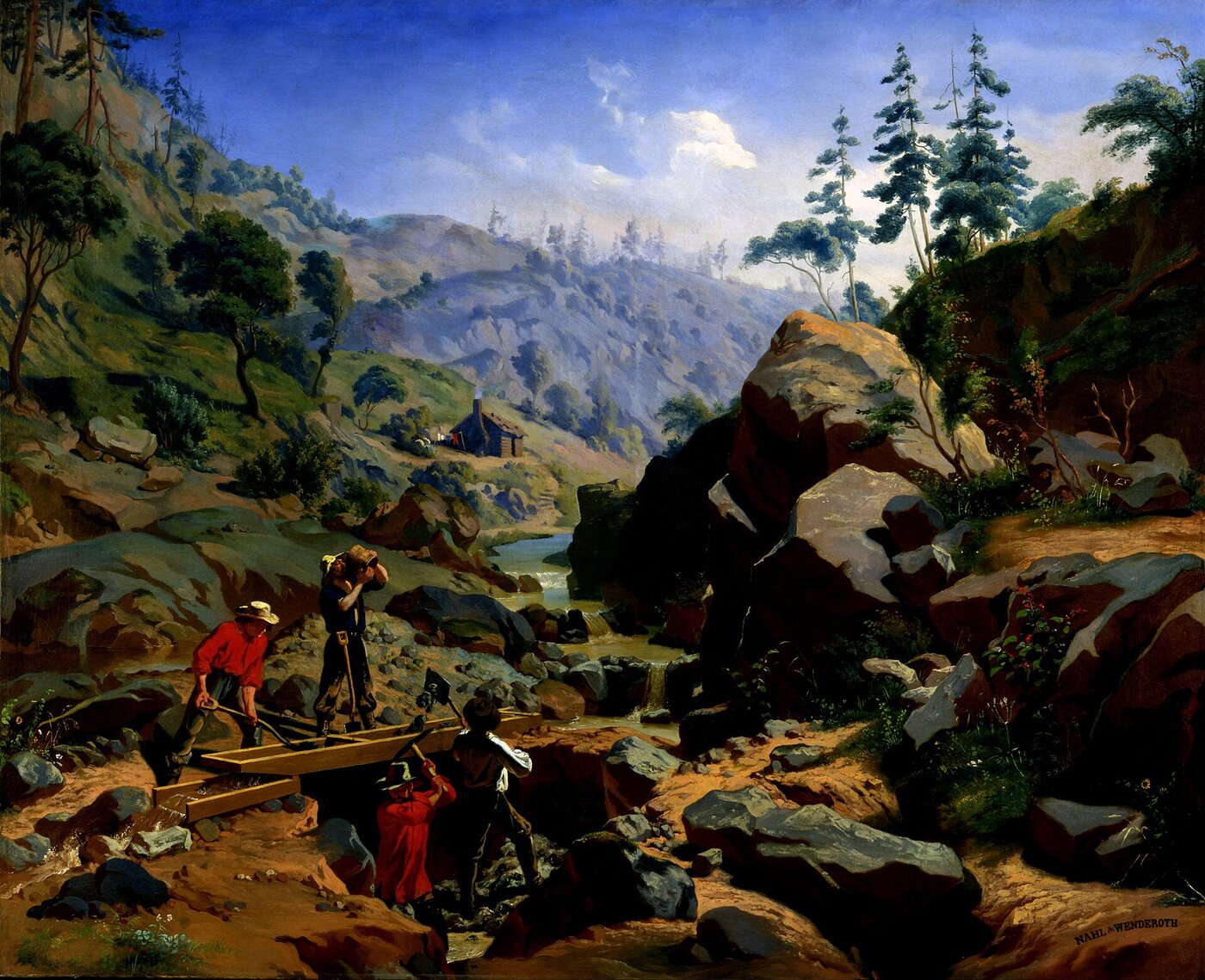
On January 24, 1848, a carpenter named James W. Marshall found flakes of gold in the tailrace of a sawmill he was building for John Sutter on the American River in California. Days later the Treaty of Guadalupe Hidalgo transferred California from Mexico to the United States, so the greatest gold discovery in American history passed almost immediately into American hands. Local workers deserted the fields and shops for the diggings, and by December President Polk confirmed the discoveries to Congress. In 1849 the world rushed in: some eighty thousand people reached California that year alone, by sea around Cape Horn or across Panama, and by the overland trails.
The forty-niners came from every continent: Americans from the eastern states, Mexicans and Chileans with mining experience, Chinese from Guangdong, Europeans, Australians, and Hawaiians. San Francisco exploded from a village of about a thousand people into a chaotic city of tens of thousands, with canvas tents, astronomical prices, and fortunes made more reliably by merchants than by miners. California's non-Indigenous population reached perhaps three hundred thousand within five years. Mining camps sprang up across the Sierra Nevada foothills, rough male societies governed by improvised miners' codes, where a good claim could yield astonishing sums and most men found barely enough to stay.
The easy gold did not last. Individual placer mining gave way within a decade to capital-intensive operations: hydraulic mining that blasted entire hillsides with water cannon, and deep quartz mining financed by companies. The environmental damage was severe, clogging rivers with debris that flooded farms downstream until courts curbed hydraulic mining in the 1880s. The human costs fell hardest on others: California's Indigenous peoples suffered violence, enslavement under legal cover, and a catastrophic population collapse, while a Foreign Miners' Tax of 1850 and repeated violence drove out many Mexican and Chinese miners. Discrimination against the Chinese, continued on the Chinese Exclusion page, began in the goldfields.
The rush remade the nation. Gold poured into the American and world economies, California entered the Union as a free state in 1850 as part of the Compromise of 1850, and the new wealth financed banks, steamship lines, and eventually the western end of the transcontinental railroad. San Francisco became the Pacific coast's great city, and agriculture flourished as mining declined. The gold rush also fixed an enduring image in American culture: the idea of the West as a place where a lucky break could remake a life, and the reality that such booms enriched few while displacing many.
 Britannica: California Gold Rush
Britannica: Sutter's Mill