 Go Back

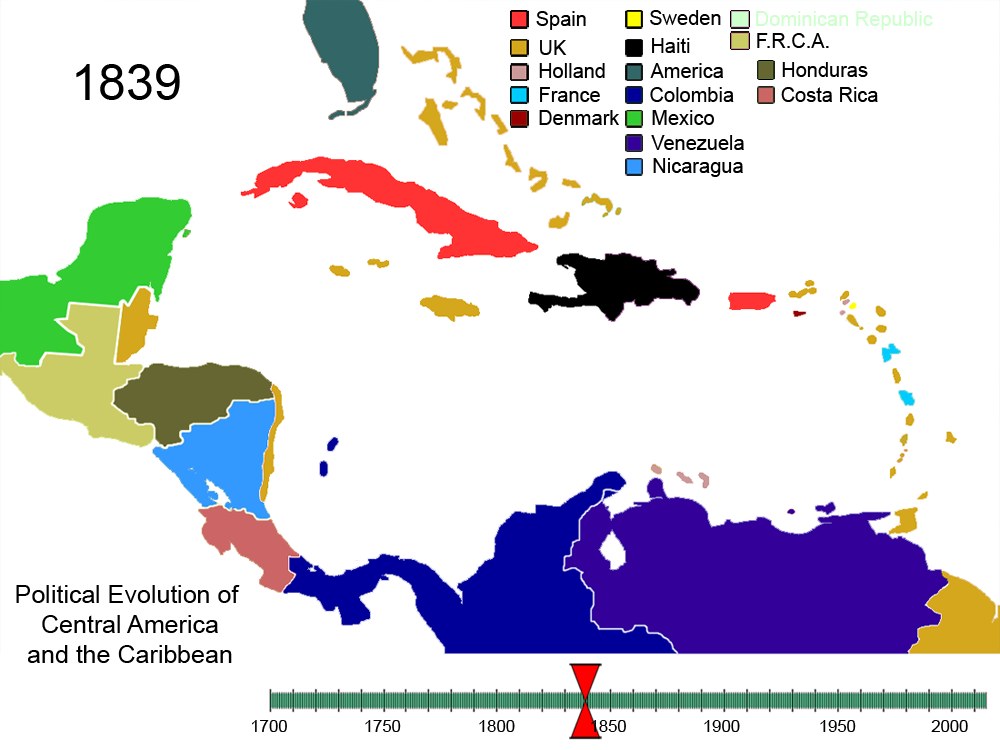
The Federal Republic of Central America was an ambitious attempt to keep the five former Spanish provinces of Central America united after independence, and its failure shaped the region's political map to this day. When Mexico's Agustín de Iturbide abdicated in 1823, the Central American provinces of Guatemala, El Salvador, Honduras, Nicaragua, and Costa Rica, which had been briefly annexed to his empire, declared their independence and formed a federation modeled on the United States. A constituent assembly in Guatemala City drafted a constitution in 1824, creating a federal republic with an elected president, a congress, and a senate.
The federation's first and most celebrated leader was Francisco Morazán, a Honduran lawyer and general who became the republic's great champion. Morazán led the Liberal faction, which favored free trade, secular education, and limits on the power of the Catholic Church. The Liberals faced fierce opposition from Conservatives, who defended the church's privileges and the interests of the old colonial elite centered in Guatemala City. Morazán won the civil war of 1826-1829, captured the capital, and pushed through liberal reforms, moving the federal capital to San Salvador.
The republic was chronically weak, however. The federal government lacked money, a real army, and the loyalty of the state governments, which frequently defied it. Geography worked against unity too: rugged mountains and terrible roads made the states feel like separate worlds. In 1837 a massive cholera epidemic swept Guatemala, and Conservative agitators convinced terrified peasants that Liberal officials had poisoned the wells. The resulting uprising, led by the charismatic Rafael Carrera, destroyed Liberal power in Guatemala, and the federation began to disintegrate as Nicaragua, Honduras, and Costa Rica seceded in 1838-1839.
Morazán fought on desperately to restore the union, even returning from exile in 1842 to seize power in Costa Rica, but he was overthrown and executed by firing squad in San José that same year. The dream of Central American unity never entirely died: several attempts at reunion followed in the nineteenth century, and the five nations still share the five-volcano motif on their flags and a common court and parliament today. Morazán himself is honored as a national hero in Honduras and El Salvador, and Honduras's Morazán department bears his name.
 Wikipedia: Federal Republic of Central America
 World History Encyclopedia: Federal Republic of Central America
 Encyclopedia.com: Central America, United Provinces of
Country Studies (Library of Congress): Honduras: The United Provinces of Central America