 Go Back

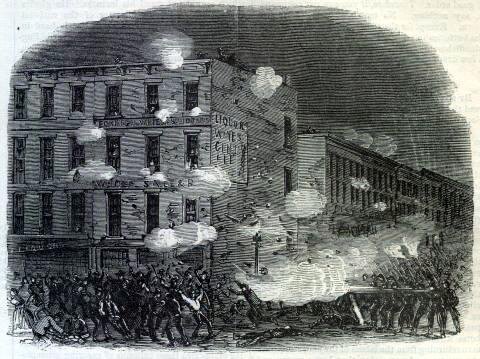
The Civil War demanded more from civilians than any previous American conflict. Both governments raised armies first by volunteers, then by conscription: the Confederacy adopted a draft in 1862 and the Union followed in 1863. The Union draft allowed the wealthy to hire substitutes or pay a commutation fee, and in July 1863 working-class New Yorkers, many of them Irish immigrants, exploded in four days of draft riots, attacking draft offices and murdering Black residents before troops from Gettysburg restored order. To pay for the war the Union printed greenback paper money, sold bonds to ordinary citizens through the banker Jay Cooke, and levied the first federal income tax, while a Republican Congress passed the Homestead Act, the Morrill land-grant college act, and the Pacific Railway Act, all in 1862.
Women kept both societies running. They took over farms, plantations, and family businesses, worked in arsenals and government offices, and served by the thousands as nurses, work once thought unsuitable for women. Dorothea Dix became superintendent of Union army nurses, Clara Barton carried supplies to the front lines and later founded the American Red Cross, and the United States Sanitary Commission, a civilian relief organization run largely by women volunteers, raised millions of dollars and policed camp hygiene. In the Confederacy, women organized relief societies and worked in hospitals such as Richmond's vast Chimborazo.
Both governments faced dissent. In the North, Peace Democrats, branded Copperheads, denounced the war and emancipation; their leader Clement Vallandigham was arrested and banished to the Confederacy in 1863 after Lincoln's administration suspended the writ of habeas corpus. In the South, food shortages and inflation sparked bread riots in Richmond and other cities in 1863, desertion drained the army, and poor farmers grumbled that it was a rich man's war and a poor man's fight, resenting the draft exemption for large slaveholders.
The home front decided the war as surely as the battlefields. The Union's ability to finance, equip, and replace its armies grew stronger every year, while the Confederacy's economy collapsed under blockade and inflation. The war also permanently enlarged the federal government's role in the economy and daily life, and it moved women into public and paid work on a new scale, experience many carried into the postwar suffrage and reform movements.
 Britannica: Draft Riot of 1863
 Library of Congress: Abraham Lincoln Papers
Britannica: Clement L. Vallandigham