 Go Back

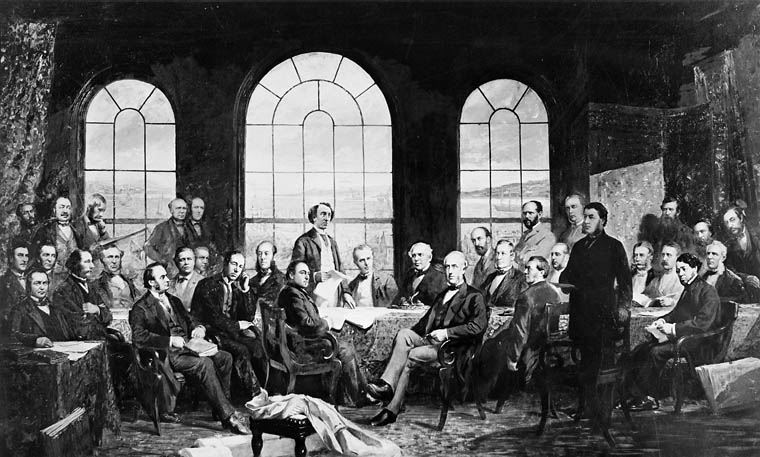
The Confederation of Canada. The Confederation of Canada was the process by which three British North American provinces—the Province of Canada, Nova Scotia, and New Brunswick—united to form the Dominion of Canada on July 1, 1867. Negotiated through a series of constitutional conferences in Charlottetown, Quebec, and London, this political union matters because it established a self-governing federal dominion within the British Empire, creating a stable political framework for westward continental expansion.
Driven by political deadlock in the united Canadas, economic desire for transcontinental railways, and fears of potential invasion or expansion from the United States following the American Civil War, Canadian statesmen like Sir John A. Macdonald forged a federal system balancing French and English interests. Over subsequent decades, Canada peacefully absorbed vast northern and western territories, indigenous homelands, and additional provinces, transforming into a modern transcontinental nation-state.