 Go Back

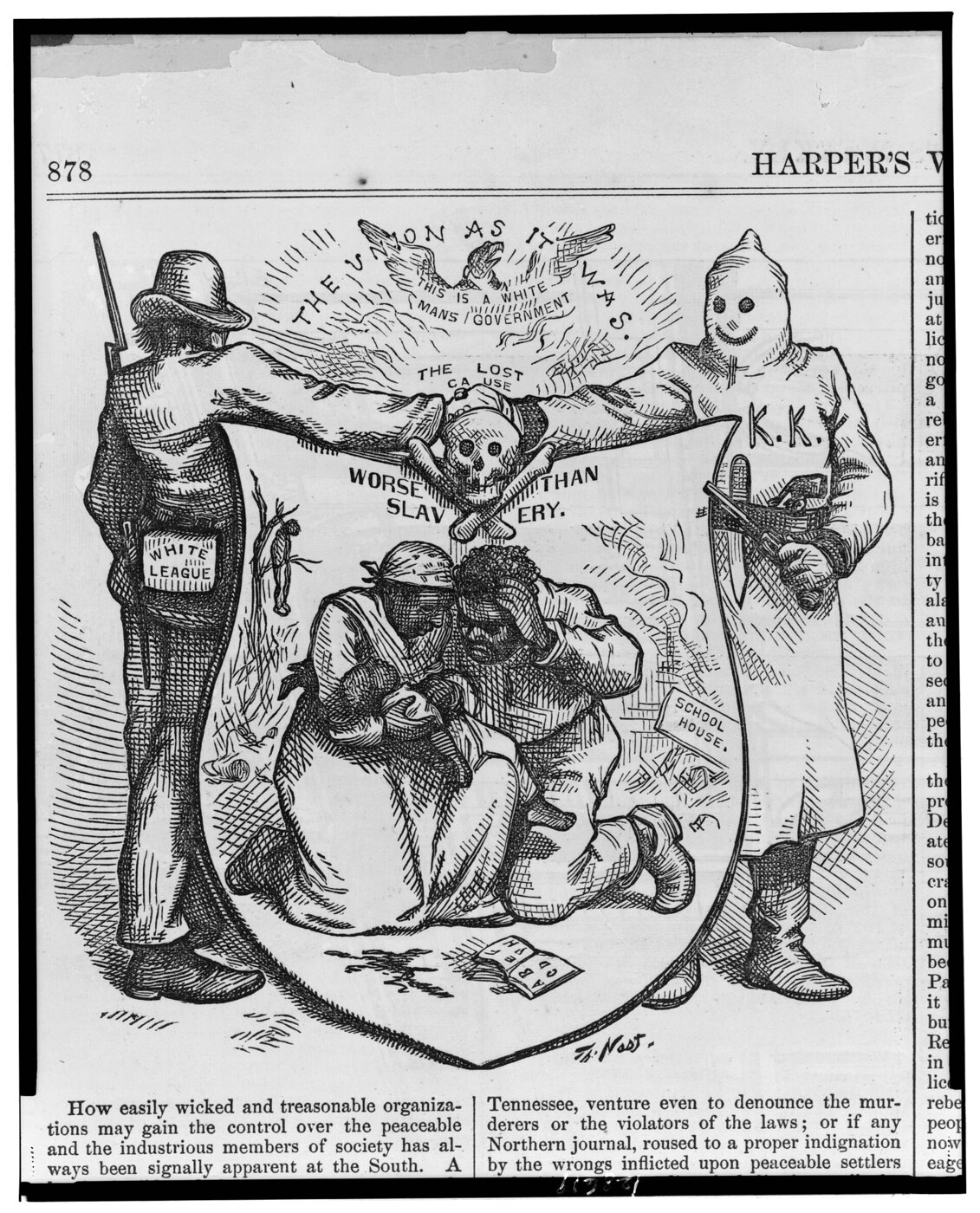
Reconstruction died of exhaustion, violence, and political retreat. Northern voters wearied of southern conflict after the Panic of 1873 plunged the country into depression, and Democrats, calling themselves redeemers, recaptured southern state governments one by one through a combination of economic pressure, propaganda, and paramilitary terror against Black voters. Federal enforcement waned as the Supreme Court narrowed the reach of the Reconstruction amendments in cases like the Slaughterhouse Cases of 1873 and United States v. Cruikshank in 1876.
The disputed presidential election of 1876 finished the process. Democrat Samuel Tilden won the popular vote, but the electoral votes of three southern states were contested. In the informal Compromise of 1877, Democrats accepted the Republican Rutherford B. Hayes as president in exchange for the withdrawal of the last federal troops from the South. The remaining Republican governments collapsed, and Black southerners were left to face the redeemers alone.
Over the following generation the southern states built the Jim Crow system. Laws segregated railroads, schools, hospitals, and public spaces, and in Plessy v. Ferguson in 1896 the Supreme Court upheld segregation as separate but equal. Beginning with Mississippi in 1890, states stripped Black men of the vote through poll taxes, literacy tests, understanding clauses, and white primaries, wiping out the Fifteenth Amendment's promise. Lynching and racial terror enforced the order - between 1889 and 1918 alone, lynching mobs killed 3,224 people, 2,522 of them Black - and convict leasing returned thousands to forced labor.
Black Americans resisted from the start. The journalist Ida B. Wells risked her life documenting lynching in the 1890s, and communities defended schools, churches, and businesses. As conditions worsened, hundreds of thousands left the South in the Great Migration that swelled after 1915, and racial violence followed them north, from the Red Summer of 1919 to the destruction of Tulsa's Black Wall Street in 1921. The revived Ku Klux Klan of the 1910s and 1920s showed how deeply Jim Crow's logic had spread beyond the South by 1924.
 Britannica: Jim Crow Law
 PBS: The Rise and Fall of Jim Crow
Britannica: Plessy v. Ferguson