 Go Back

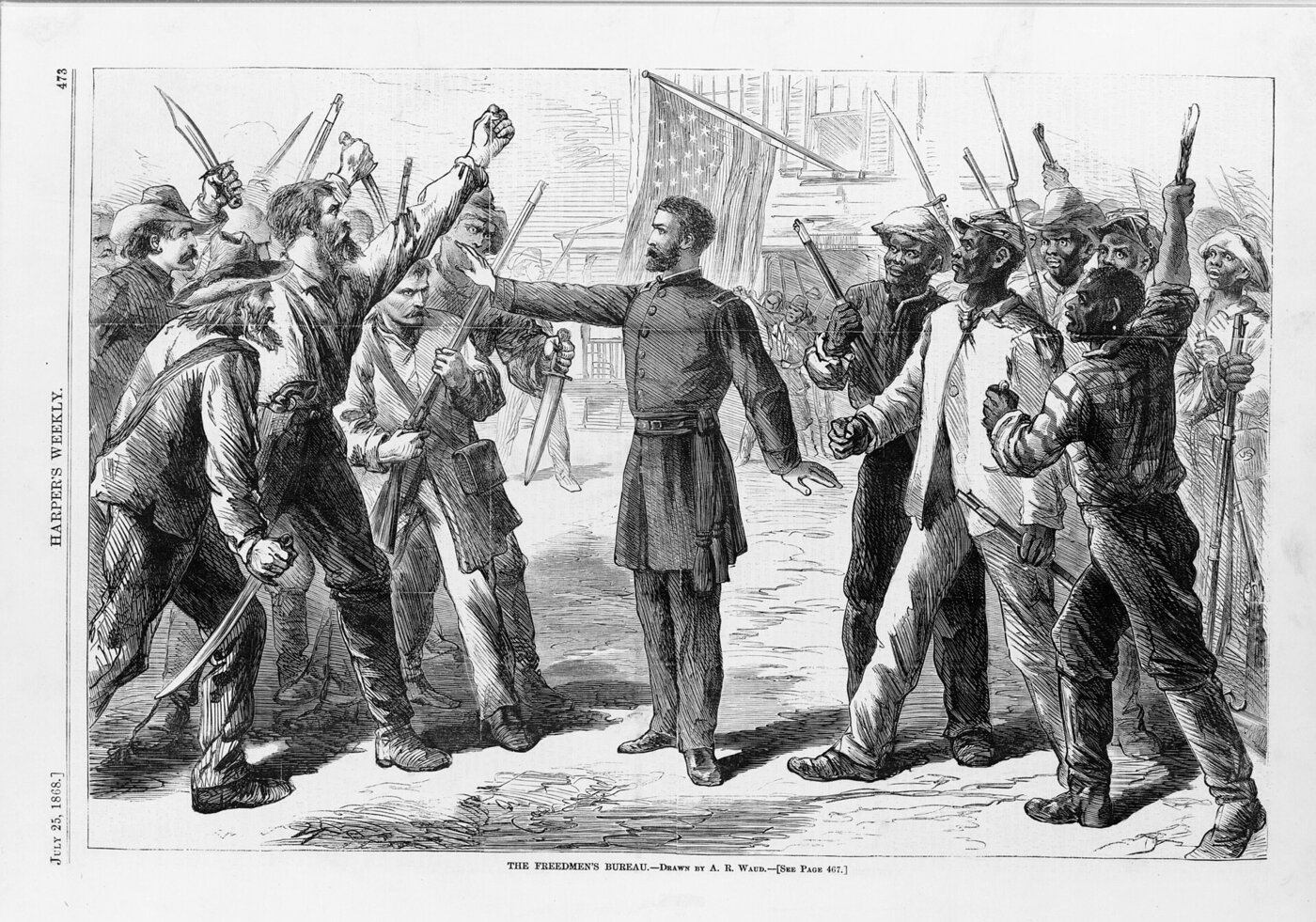
In March 1865, weeks before the Civil War ended, Congress created the Bureau of Refugees, Freedmen, and Abandoned Lands, known as the Freedmen's Bureau, to manage the transition from slavery to freedom in the devastated South. Under General Oliver O. Howard, the Bureau fed the hungry, white and Black alike, ran hospitals, reunited families separated by slavery, legalized marriages performed under bondage, and supervised labor contracts between freedpeople and planters. It was the first large federal social welfare agency in American history, and in its peak years it operated in every former Confederate state with only about nine hundred agents.
The Bureau's greatest success was education. Freedpeople, long forbidden to learn to read, demanded schools with extraordinary determination, organizing their own classes and raising money from poverty itself. Working with northern missionary and freedmen's aid societies and with Black communities, the Bureau helped establish thousands of schools serving hundreds of thousands of students. It also supported new colleges for Black students, including Howard University in Washington, Fisk in Nashville, and Hampton in Virginia, institutions that educated Black teachers and leaders for generations.
The central question was land. In January 1865 General William T. Sherman's Field Order 15 had set aside coastal land in South Carolina and Georgia for freed families, forty-acre plots that gave rise to the phrase forty acres and a mule. The Bureau held hundreds of thousands of acres of abandoned and confiscated land that freedpeople hoped to receive. President Johnson ordered nearly all of it restored to former owners in 1865, and Congress never enacted land redistribution. Without land, most freedpeople had to work for their former enslavers, and the Bureau's supervised labor contracts evolved into sharecropping and crop liens that trapped Black farmers in debt for generations.
The Bureau fought constant opposition: President Johnson vetoed its renewal before Congress overrode him, southern whites denounced it, and it was always underfunded and understaffed. Congress let it expire in 1872. Its relief work saved countless lives and its courts offered freedpeople a rare forum for justice, but its failure on land shaped the South's poverty and racial hierarchy for a century. The schools and colleges it planted were its most durable monument, anchoring Black education through the era of segregation.
 Britannica: Freedmen's Bureau
 BlackPast: Freedmen's Bureau, 1865-1872
Britannica: Sharecropping