 Go Back

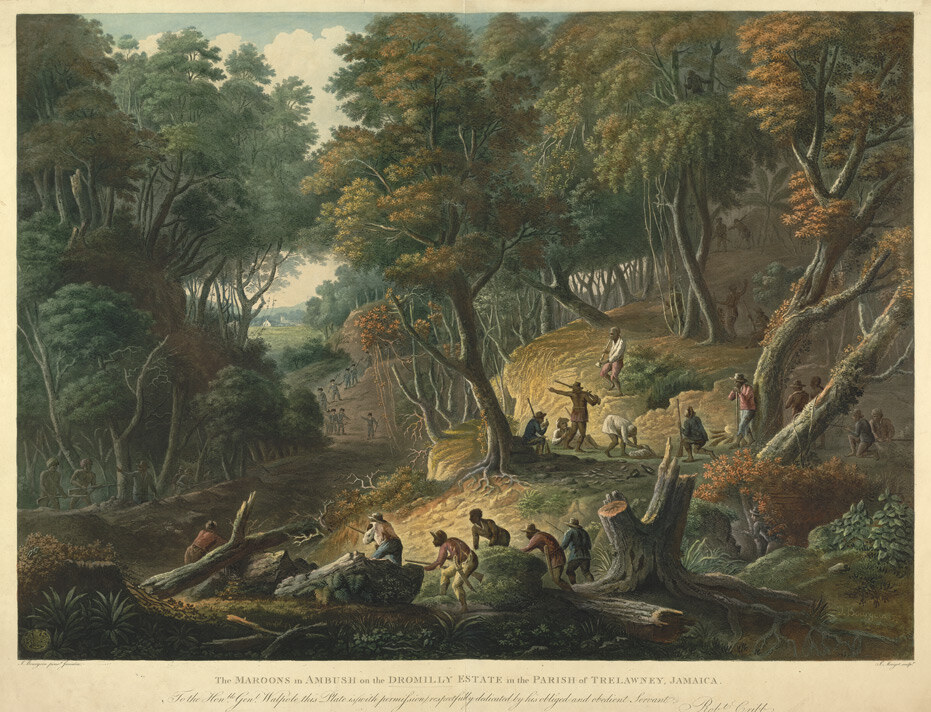
Across the slaveholding Americas, men and women who fled the plantations built free communities in wild country, and nowhere did they succeed so completely as in Jamaica. The island's Maroons began with the Africans freed or abandoned when Britain seized Jamaica from Spain in 1655; reinforced by generations of runaways from the sugar estates, they formed two nations: the Leeward Maroons in the cockpit country of Trelawney and the Windward Maroons in the Blue Mountains. From these near-impenetrable refuges, ruled by their own chiefs and councils, they raided plantations, drew off more fugitives, and defeated every army sent against them for eighty years.
Maroon strength rested on mastery of the land and of guerrilla war. They farmed hidden provision grounds, communicated across the mountains with the abeng horn, and ambushed British columns in country where redcoats could not form a line. Under leaders like the Windward chief Nanny, the Maroons' most famous commander, and the Leeward chief Cudjoe, the Maroons fought the First Maroon War to exhaustion on both sides. In 1739 Cudjoe forced Britain to a treaty recognizing the Maroons' freedom and their lands, in return for an end to raids and a promise to return future runaways; Nanny's people signed the following year.
The treaties held for half a century, then broke in blood. In 1795 a dispute over the flogging of two Trelawney Maroons exploded into the Second Maroon War, and five hundred Trelawney Maroons tied down thousands of British troops for five months. Beaten by imported bloodhounds and tricked by a negotiated surrender, nearly six hundred Trelawney Maroons were deported first to Nova Scotia and then, in 1800, to Sierra Leone - a betrayal that emptied the most defiant Maroon nation. The Windward Maroons of Moore Town, Charles Town, and Scott's Hall remained, and their lands survive today.
The Maroons proved that enslaved Africans could defeat the British Empire and force it to recognize their freedom, and their example shadowed every Jamaican slaveholder thereafter. Their treaties of 1739-40 were among the first recognitions of a free Black polity in the British Atlantic, and the maroon ideal - freedom won and defended in the mountains - inspired later generations of Jamaican resistance, from the Baptist War of 1831-32 to Morant Bay in 1865.
 Britannica: Maroon
 BlackPast: Queen Nanny of the Maroons
Britannica: Jamaica (history)