 Go Back

The Kingdom and Empire of Haiti. The Kingdom and Empire of Haiti (1804-1820) arose from the world's only successful slave revolution. When Haiti declared independence in 1804, its leaders faced the task of building a state from a shattered plantation society. Jean-Jacques Dessalines, the hero of the war, proclaimed himself emperor in 1804, but after his assassination in 1806 the country split in two: a republic in the south under Alexandre Petion, and in the north the kingdom of Henri Christophe, a former slave who had become one of the revolution's greatest generals and who was crowned King Henry I in 1811.
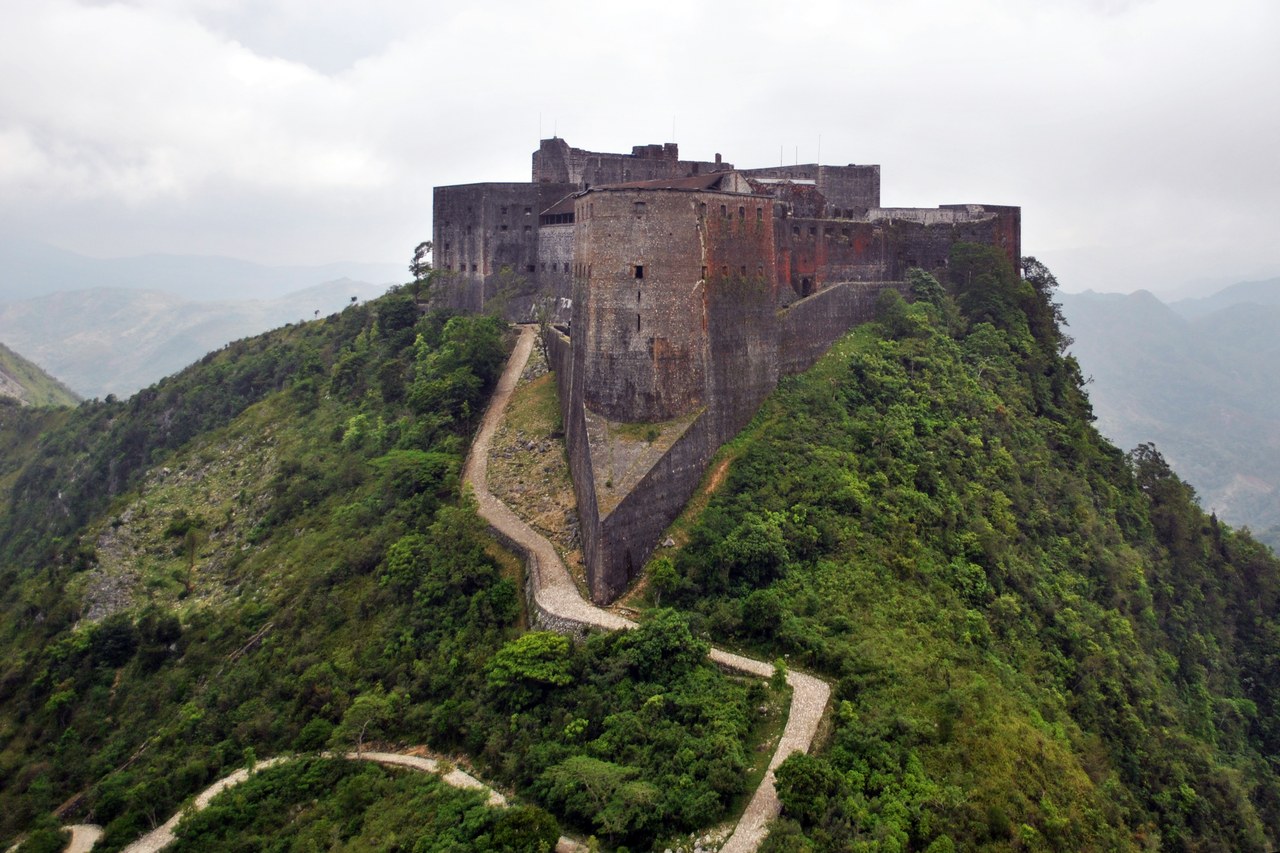
Christophe's kingdom was an astonishing experiment in Black statehood. The king created a Haitian nobility with dukes and barons, a court, an army, and a code of laws, and he drove his people to rebuild the economy and raise monuments to their freedom. The greatest of these was the Citadelle Laferriere, the vast fortress on the peak above Cap-Haitien, built to defy any French attempt to reconquer the island, and below it the palace of Sans-Souci, the Versailles of the Caribbean. Yet Christophe's rule was severe: his system of forced plantation labor kept the estates producing but weighed heavily on the people.
The kingdom did not outlive its founder. In 1820, stricken by paralysis and facing revolt, Christophe shot himself in his palace; his heir was soon murdered, and the north was absorbed into the southern republic of Jean-Pierre Boyer, which reunited Haiti and then ruled the whole island of Hispaniola for two decades. Dessalines' empire and Christophe's kingdom alike passed into legend.
Their meaning endures. The Black kingdom and empire of Haiti proved that the revolution was no accident and that a state founded by freed slaves could govern itself and build monuments to rival those of Europe. The Citadelle, now a UNESCO World Heritage site, remains the supreme symbol of Haitian independence.
 Wikipedia: Kingdom of Haiti
Library of Congress Country Studies: Christophe's Kingdom and Petion's Republic
 The Conversation: Inside the Kingdom of Haiti
 Duke Haiti Lab: The Regime of Henry Christophe