 Go Back

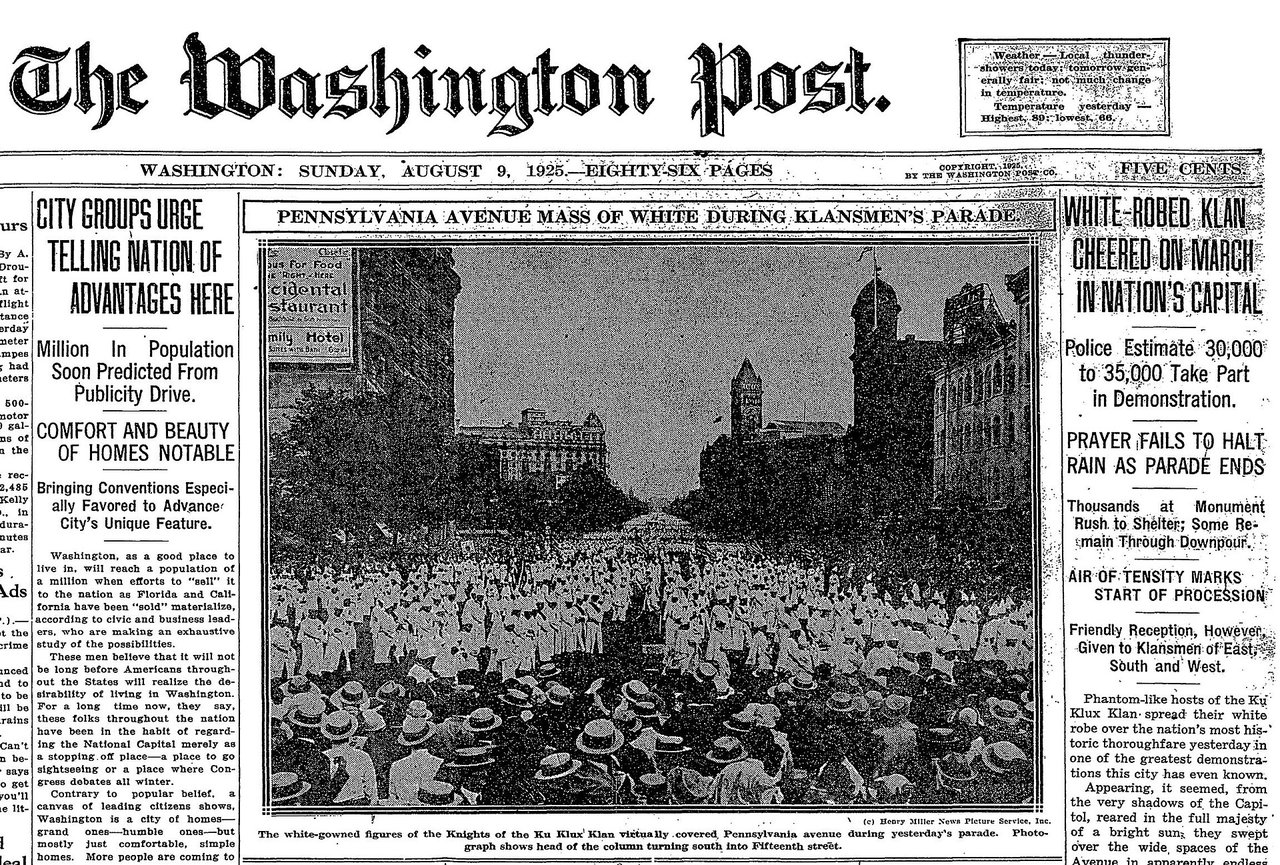
The Ku Klux Klan's Revival in the 1920s. The first Klan died with Reconstruction; the second was born in 1915 on Stone Mountain, Georgia, where William J. Simmons, an Alabama fraternal organizer, lit a cross to mark the premiere year of The Birth of a Nation, the film that made the old Klan the heroes of America's first blockbuster. The new Klan was reborn into a different America and multiplied its hatreds to match: not only Black Americans but Catholics, Jews, immigrants and 'bootleggers' - a 'hundred percent Americanism' for a nation unsettled by the great immigration, the war and the cities.
What made the second Klan astonishing was its reach. Organized by professional promoters on a ten-dollar commission per robe, it grew by 1924 to perhaps four million members - not in the old Confederacy's heart but in Indiana (where the Grand Dragon effectively ran the state), Oregon, Colorado, Maine, the cities of the Midwest. It marched forty thousand strong down Pennsylvania Avenue in 1925; it elected senators, governors and mayors; it packed picnics and 'naturalization' ceremonies into America's county fairs. It was, for a few years, the largest fraternal movement in the country - and a money machine for its founders.
The collapse, when it came in 1925, was as much farce as defeat: D.C. Stephenson, the Indiana Grand Dragon and the Klan's most powerful man, was convicted of the rape and murder of Madge Oberholtzer, and the membership - sold Protestant morality - fled by the million; exposes of the leaders' corruption did the rest. By the decade's end the Klan had shrunk back to a Southern terrorist remnant.
The second Klan remains the darkest mass movement of the American 1920s, and its rapid rise and fall the century's warning about respectable bigotry: a nationwide organization, built by marketing on fear of the immigrant and the changing city, that captured state governments before its own corruption destroyed it. Its enemies - Catholics, Jews, immigrants - supplied the America that outvoted it.
 Britannica: Ku Klux Klan
Britannica: The Birth of a Nation