 Go Back

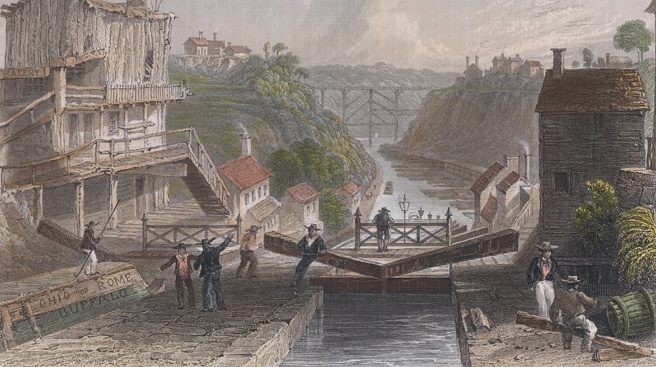
In the early nineteenth century, improved transportation helped connect American farms, towns and workshops to larger markets. Historians call the change the market revolution, and it was not one invention or a sudden replacement of household production. Roads, canals, steamboats and later railroads altered the distance over which goods could be sold and the cost of moving them - and places with access to these networks gained opportunities that more isolated communities could not share. Its leading example, and its loudest triumph, was a ditch dug across New York: the Erie Canal.
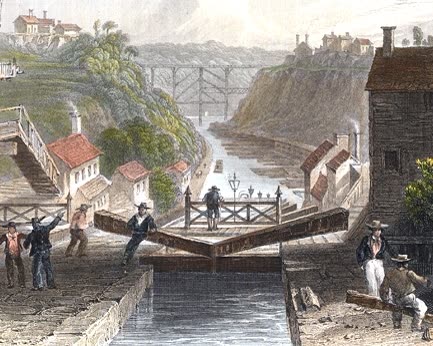
A canal from the Hudson River to the Great Lakes had been proposed since the 1780s, surveyed in 1808, and dismissed as fantasy by nearly everyone. New York governor DeWitt Clinton made it his cause, and in 1817 the state legislature authorized construction; opponents sneered at 'Clinton's Folly' and 'Clinton's Big Ditch'. Ground was broken at Rome, New York, on 4 July 1817. The engineering case was simple arithmetic: a mule can carry about 250 pounds on its back but can draw a 60,000-pound barge along a towpath, so a working canal could cut transport costs by about 95 percent. Workers dug the channel largely by hand, with animals and machinery in support - local laborers and, increasingly, Irish immigrants whose communities later dotted the canal towns.
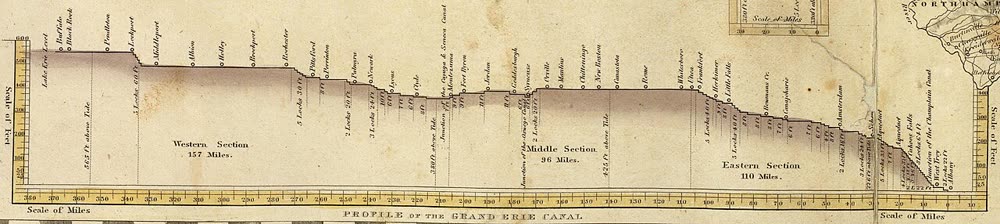
The canal was officially completed on 26 October 1825: 363 miles from the Hudson near Albany to Lake Erie at Buffalo, climbing some 565 feet through a staircase of locks, the first navigable waterway between the Atlantic and the upper Great Lakes. New York celebrated with a Grand Celebration - a ninety-minute cannonade relayed by cannon shots along the whole length of the canal and the Hudson, from Buffalo to New York City. Then a flotilla led by Governor Clinton aboard the Seneca Chief sailed the canal for ten days, and at New York Harbor Clinton ceremonially poured a keg of Lake Erie water into the Atlantic: the 'Wedding of the Waters'. The Seneca Chief carried a keg of Atlantic water home to Buffalo for the return toast. The canal was an instant commercial success - toll revenue covered the state's construction debt within its first year of operation.
The consequences remade the map. Buffalo, chosen as the canal's western terminus over neighboring Black Rock, grew into a great city and absorbed its rival; Rochester boomed on Genesee flour; Syracuse, Utica and Lockport became canal towns. Midwestern wheat poured east - after Britain repealed its Corn Laws, exports to Europe surged - while Eastern machinery and manufactured goods moved west at prices settlers could afford. Freight costs collapsed, food got cheaper in Eastern cities, and New York City, sitting at the canal's Hudson outlet, pulled decisively ahead of every American rival port. The canal's peak year came in 1855 with 33,000 commercial shipments, and for decades it carried westbound immigrants as well as cargo. Its success provoked a national canal-building boom, and its example made transportation infrastructure a central question of public policy and private enterprise alike.
The market revolution reached well past the towpath. Merchants coordinated shipments, credit and sales across a widening area; households increasingly bought goods they might previously have made themselves; workshops and farms adjusted production for buyers they would never meet. The benefits were uneven - a route favored one port over another, and dependence on distant prices and credit exposed producers to forces beyond their control, a lesson canal towns learned in every downturn. Railroads later changed the competitive landscape, and the Erie's own tolls were abolished in 1902. But the pattern held: the market revolution was a change in relationships as much as movement, binding households, workers and communities to distant customers and suppliers - bringing opportunity, and new dependencies, into the expanding republic.
 Smithsonian: An Artificial River
 Britannica: Erie Canal