 Go Back

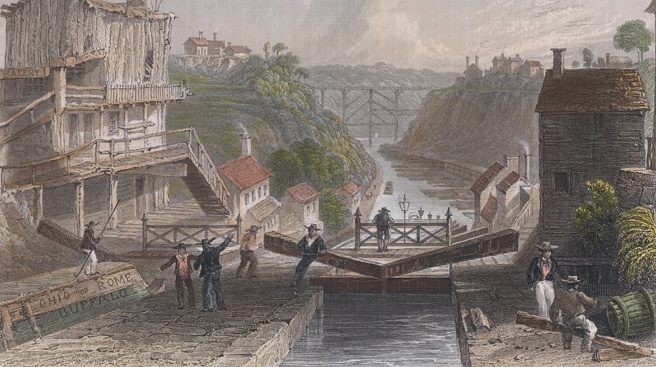
During the early nineteenth century, improved transportation helped connect American farms, towns and workshops to larger markets. This change formed part of what historians call the market revolution. It was not one invention or a sudden replacement of household production. Instead, roads, canals and other connections altered the distance over which goods could be sold and the cost of moving them. Places with access to these networks gained opportunities that more isolated communities could not share equally.
The Erie Canal became a leading example. Built between 1817 and 1825, it linked Lake Erie with the Hudson River, creating a route between the Great Lakes and New York City. Farmers could send produce toward the coast, while manufactured goods moved inland. Canal construction required finance, engineering and hard physical labor. Workers dug much of the channel by hand, supported by animals and machinery, and the project employed local people as well as immigrants.
Transportation improvements supported commercial agriculture and the growth of trading centers. Merchants coordinated shipments, credit and sales across a wider area. Households increasingly purchased goods they might previously have produced themselves, while workshops and farms adjusted production for distant buyers. The benefits were uneven: a route could favor one port over another, and dependence on prices and credit exposed producers to forces beyond their control. The experience of canal towns shows how a new transportation route could reshape local work and commercial prospects.
The success of canals encouraged further investment, while railroads later changed the competitive landscape. New York City's growth was closely tied to its position at the end of the Erie route. These developments made transportation infrastructure an important matter for public policy and private enterprise alike. The market revolution should therefore be understood as a change in relationships as well as movement: households, workers and communities became more closely connected to distant customers and suppliers. Greater exchange brought opportunity, but also new dependencies and inequalities within the expanding republic. Canal traffic was two-way: westward shipments carried consumer goods, while eastward cargoes brought agricultural products toward ports and their merchants.
 Smithsonian: An Artificial River
 Britannica: Erie Canal