 Go Back

The Métis emerged from the fur trade as a distinct nation: children of First Nations mothers and French, Scottish, and English trader fathers, bound together by their own language, Michif, their Catholic and Protestant parishes, and the great semi-annual buffalo hunts of the Red River Settlement. When Canada arranged to buy the Hudson's Bay Company's vast territory of Rupert's Land in 1869, nobody consulted the roughly twelve thousand people of Red River. Canadian surveyors arrived marking out square lots across Métis river farms, and Ottawa's appointed governor was on his way. The Métis, led by the young, educated Louis Riel, decided their future would not be settled over their heads.
In the autumn of 1869 the Métis National Committee blocked the governor's entry and seized Upper Fort Garry, and Riel formed a provisional government to negotiate terms of union. Its List of Rights produced the Manitoba Act of 1870, which brought Manitoba into Confederation with provincial status, language and school protections, and 1.4 million acres reserved for the children of Métis families. But the provisional government's court martial and execution of the belligerent Orangeman Thomas Scott made Riel a marked man in English Canada; when troops under Colonel Garnet Wolseley arrived in August 1870, Riel fled into exile. In the following years fraud and speculation stripped many Métis of their promised lands, and thousands moved west to the Saskatchewan country.
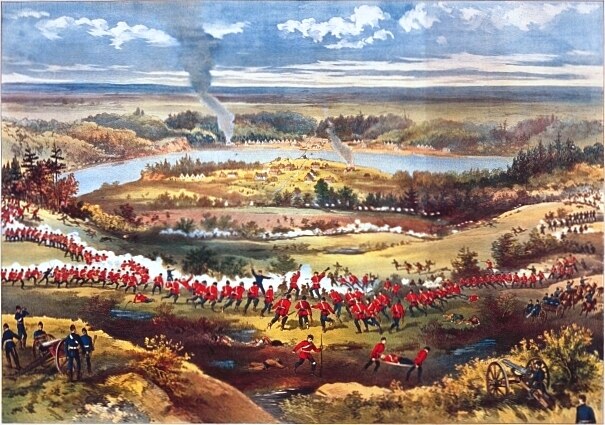
There the pattern repeated: the buffalo collapsed, Ottawa ignored petitions over land and hunger, and in 1884 the Saskatchewan Métis sent for Riel. In March 1885 he proclaimed a second provisional government at Batoche, with the veteran hunt captain Gabriel Dumont as his general. The North-West Resistance that followed drew in some Cree as well: fighters of Wandering Spirit killed nine men at Frog Lake, while the great chiefs Poundmaker and Big Bear struggled to restrain their young men. Dumont beat back the Mounted Police at Duck Lake and held off General Middleton's column at Fish Creek, but Canadian soldiers carried the Métis lines at Batoche after four days of fighting in May 1885. Riel surrendered on 15 May.
Riel was tried at Regina for high treason, and although the jury begged for mercy, Prime Minister John A. Macdonald let the sentence stand; he was hanged on 16 November 1885. Eight Cree and Assiniboine men were hanged at Battleford that November in Canada's largest mass execution, and Poundmaker and Big Bear went to prison. The resistance's defeat opened the prairies to the railway and settlement, and the Métis, their petitions ignored and their lands largely lost, were pushed to the margins of the society they had helped create. To French Canada Riel became a martyr; to the Métis, the founder of Manitoba and the symbol of a nation's survival.
 Britannica: Louis Riel
Britannica: Red River Rebellion