 Go Back

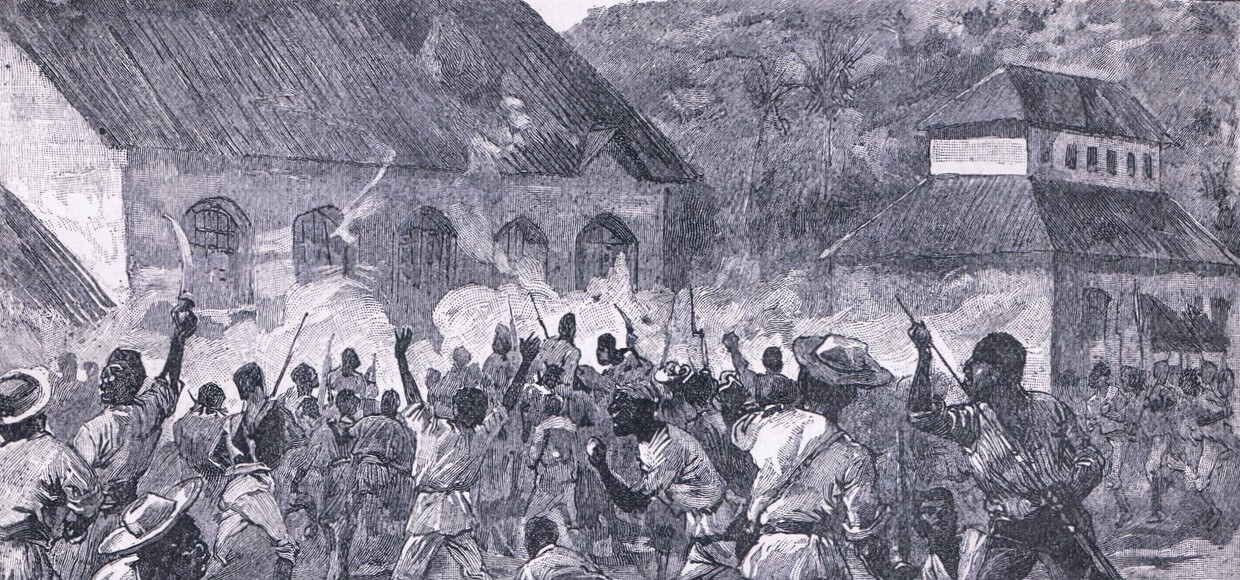
In October 1865 the parish of St. Thomas-in-the-East in Jamaica rose in the last great rebellion of the island's nineteenth century. A generation after emancipation, Jamaica's Black majority remained landless and voteless: wages on the sugar estates had collapsed, drought and the American Civil War had raised prices, a poll tax kept nearly all Black men off the electoral roll, and the courts answered their grievances with contempt. A Native Baptist deacon and landowner, Paul Bogle, had led his neighbours' protests to the colonial government; when Governor Edward Eyre ignored their petition, tension in the parish mounted toward explosion.
The spark was a court case. On 7 October 1865 a man was arrested at the Morant Bay courthouse for interrupting the trial of a squatter; when Bogle's men rescued another prisoner days later, warrants were issued, and on 11 October several hundred protesters marched on the courthouse. The volunteer militia fired into the crowd, killing seven, and the crowd stormed and burned the building, killing the custos, the parish's chief magistrate, and seventeen others. For days the rising spread through the parish's estates, and two planters were killed. Bogle's ally, the mixed-race assemblyman and Baptist advocate George William Gordon, was in Kingston when it began.
The government's vengeance vastly exceeded the rising. Eyre declared martial law, and for a month soldiers and Maroon irregulars swept St. Thomas-in-the-East: by official count 439 people were killed, more than six hundred flogged, and a thousand houses burned. Gordon was seized in Kingston, dragged into the martial-law zone, convicted by a hasty court martial, and hanged on 23 October; Bogle was hanged the next day. The brutality split Britain itself: a Jamaica Committee under John Stuart Mill demanded Eyre's prosecution while Charles Dickens and Thomas Carlyle defended him, and though Eyre was recalled and never tried, Jamaica's two-century-old assembly was abolished and the island made a Crown Colony.
Morant Bay exposed the unfinished business of emancipation: freedom without land, vote, or justice. Crown Colony rule brought some reforms but no democracy, and the struggle Bogle and Gordon died for - land, justice, and political voice - ran on into the twentieth century.
 BlackPast: Paul Bogle (1822-1865)
 Encyclopedia.com: Morant Bay Rebellion
 Britannica: Jamaica (history)