 Go Back

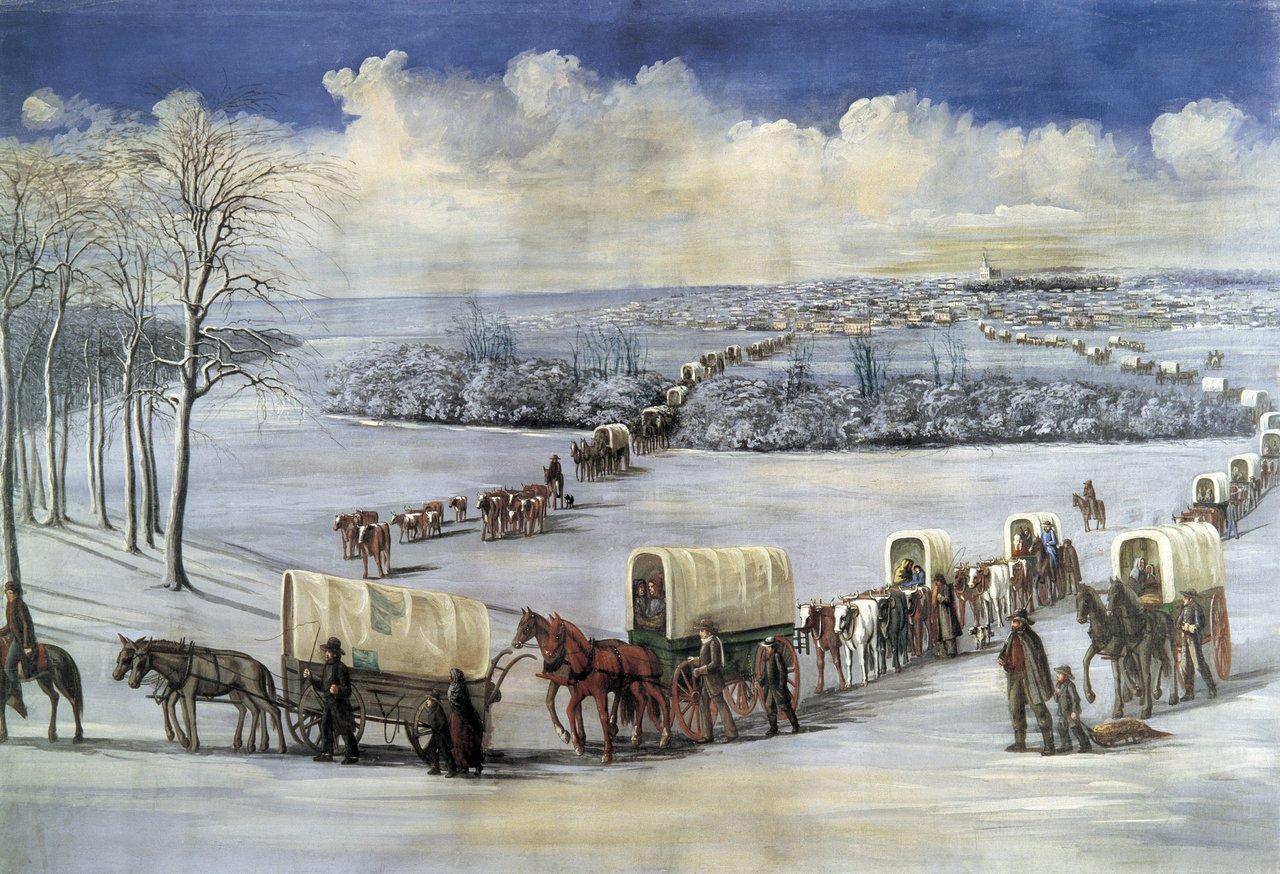
The Mormon Migration. The Church of Jesus Christ of Latter-day Saints, founded by Joseph Smith in upstate New York in 1830, gathered its converts into communities too compact and too different for their neighbors' comfort - driven successively from Ohio, Missouri and Illinois by lawsuits, mobs and, in Missouri, a governor's extermination order. In 1844 a mob killed Joseph Smith and his brother in the jail at Carthage, Illinois, and the church faced extinction or flight. Brigham Young, Smith's successor, chose flight on a scale without American precedent: the whole people would leave the United States.
The migration was organized like a campaign. In the winter of 1846 the Saints crossed the frozen Mississippi and crawled across Iowa to winter quarters on the Missouri; in April 1847 Young's vanguard company - 143 men, 3 women, 2 children - followed the Platte and the newly worn Oregon Trail, then turned through the mountains by the Donner route's fatal shortcut, made safe by advance crews, and on 24 July 1847 looked down into the Salt Lake Valley. 'This is the right place,' Young is remembered saying. By the time the handcart companies and wagon trains had finished, tens of thousands had walked the Mormon Trail.
In the desert the Saints built a kingdom: Salt Lake City laid out on the grid of a planned Zion, irrigation canals that made the Great Basin bloom - the first large-scale irrigation in American history - and settlements from Idaho to California. The kingdom collided with the republic: Young governed Utah Territory as both prophet and governor, the practice of plural marriage, announced in 1852, scandalized America, and in 1857 President Buchanan sent an army in the 'Utah War,' a near-conflict patched up without battle.
The railway and the nation's laws eventually absorbed the kingdom - statehood came only in 1896, after the church renounced polygamy - but the migration's achievement stands: a religious people transplanted itself a thousand miles into a desert and built a commonwealth. The beehive on Utah's flag still commemorates the Saints' founding virtue: industry in the wilderness.
 Britannica: Brigham Young
Britannica: Church of Jesus Christ of Latter-day Saints
 National Park Service: Mormon Pioneer National Historic Trail