 Go Back

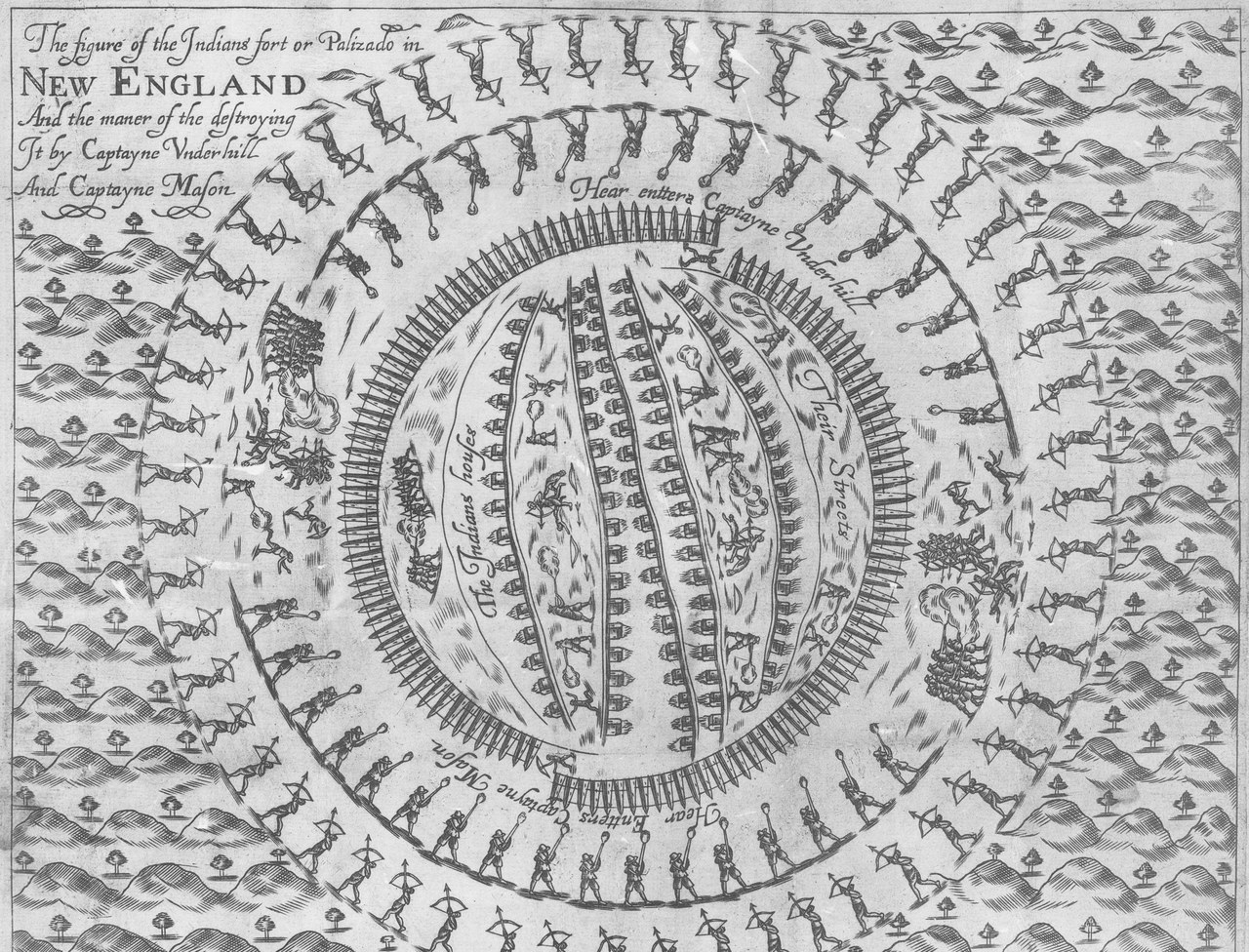
The Pequot War was fought in 1636 and 1637 between the Pequot people and a coalition of English settlers from the Massachusetts Bay, Connecticut and Saybrook colonies, joined by Native allies including the Narragansett and Mohegan. Its root was a struggle over the fur and wampum trade of the Connecticut River valley. Britannica notes that by 1635 the Pequot had extended control over modern Connecticut and eastern Long Island and headed a confederacy of dozens of tribes. Before the English arrived, the Dutch and the Pequot controlled the region's trade, and the tribes the Pequot had subjugated resented them and sought alliances with the English.
The killing of English traders, John Stone in 1634 and John Oldham in 1636, became the immediate cause of war, though Britannica stresses that those deaths came after decades of conflict among Native peoples that the Dutch and English made worse. In late August 1636 Massachusetts Bay sent about ninety soldiers under John Endecott to Block Island and Pequot territory, where they burned villages and cornfields. The Pequot then besieged the fort at Saybrook from September 1636 to April 1637. After a Pequot attack on Wethersfield, the first time women and children were killed in the war, Connecticut declared war on May 1, 1637.
Captain John Mason of Windsor was ordered to conduct an offensive war. In May 1637, in what Britannica calls the Mistick Campaign, he led English, Mohegan and Narragansett forces against the main fortified Pequot village at Mistick, in present-day Mystic, Connecticut. The attackers burned the village. Around 400 Pequot men, women and children were burned alive or killed. The woodcut on this page comes from John Underhill's 1638 account of the attack. It is a schematic print and shows the fort as a circle, not a realistic scene. The last battle of the war was the Swamp Fight at Fairfield, Connecticut.
The Pequot were defeated and their communities scattered. The 1638 Treaty of Hartford outlawed the Pequot language and name, seized tribal lands and disbanded the survivors, who were given to the victors or sold into slavery. The English claimed all Pequot territory by right of conquest, and the war cleared the way for further English colonization of southern New England. Britannica calls it an especially brutal war and the first sustained conflict between Native Americans and Europeans in northeastern North America. The Mashantucket Pequot Tribal Nation in southeastern Connecticut is, in ConnecticutHistory.org's words, proof of a people's endurance.
 Britannica: Pequot War
 ConnecticutHistory.org: Pequot War