 Go Back

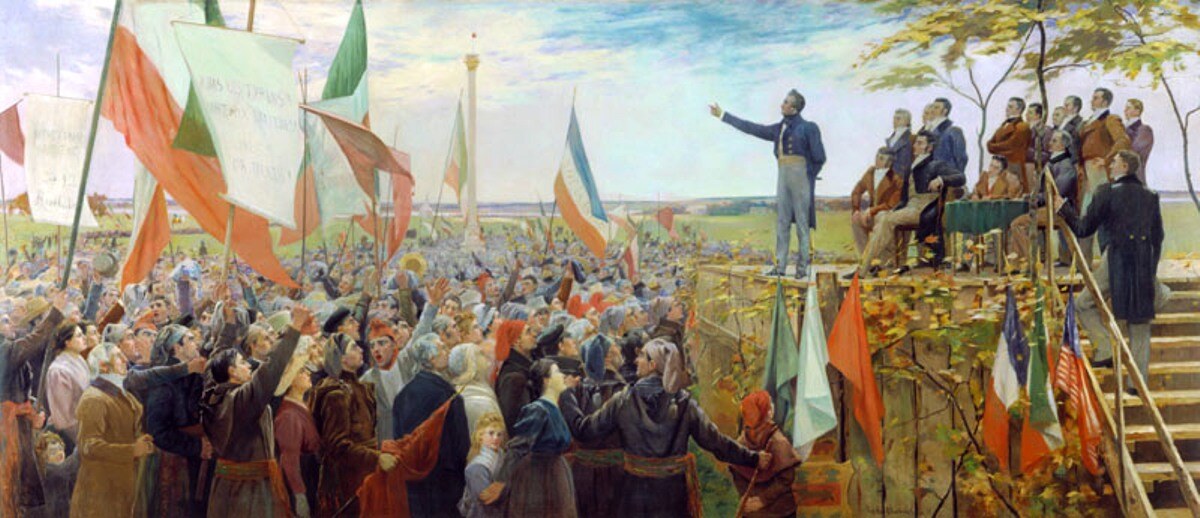
In the 1830s the two British colonies of Upper Canada (today's Ontario) and Lower Canada (today's Quebec) seethed with grievance. Real power lay with the lieutenant governors and small appointed oligarchies - the Family Compact in the upper province and the Château Clique in the lower - while elected assemblies could be ignored. In Lower Canada the conflict cut deeper still, because the English-speaking commercial minority governed a French-speaking majority, and reformers in the Parti patriote under Louis-Joseph Papineau had seen their Ninety-Two Resolutions of 1834 rejected outright. In Upper Canada the fiery journalist William Lyon Mackenzie denounced land speculation and privilege. When Britain answered reform demands with the hard-line Russell Resolutions of 1837, and an economic depression bit, armed revolt followed.
Lower Canada rose first. After a vast open-air assembly at Saint-Charles in October 1837, Patriote militants clashed with British troops: they won at Saint-Denis on 23 November, were crushed at Saint-Charles two days later, and made their last stand at Saint-Eustache on 14 December, where troops killed some seventy defenders and burned the village. Papineau and other leaders fled to the United States. A second rising in 1838, led by the Frères chasseurs under Robert Nelson, who proclaimed a Canadian republic, was defeated at Odelltown and Lacolle. Reprisals were severe: twelve Patriotes were hanged in Montreal and fifty-eight more transported to the penal colonies of Australia.
Upper Canada's rebellion was smaller and briefer. In December 1837 Mackenzie led a few hundred ill-armed farmers down Yonge Street toward Toronto, where loyalist militia scattered them near Montgomery's Tavern. Mackenzie escaped to Navy Island on the Niagara River and proclaimed a provisional government, and Canadian militia's destruction of the American supply steamer Caroline nearly dragged the United States into war. Through 1838 refugee 'Patriot' hunters launched border raids - at Short Hills, at Prescott's windmill, and near Windsor - all beaten back.
Britain sent Lord Durham to investigate. His 1839 report famously called the quarrel 'two nations warring in the bosom of a single state', urged the union of the two colonies and the assimilation of French Canadians, but also recommended that the executive answer to the elected assembly. The Act of Union joined the Canadas in 1841, and by 1848-49 responsible government was won under LaFontaine and Baldwin, peacefully securing much of what the rebels had demanded. The failed rebellions thus became a hinge on the road to Canadian self-government and, ultimately, Confederation.
 Britannica: Rebellions of 1837
 The Canadian Encyclopedia: Rebellions of 1837