 Go Back

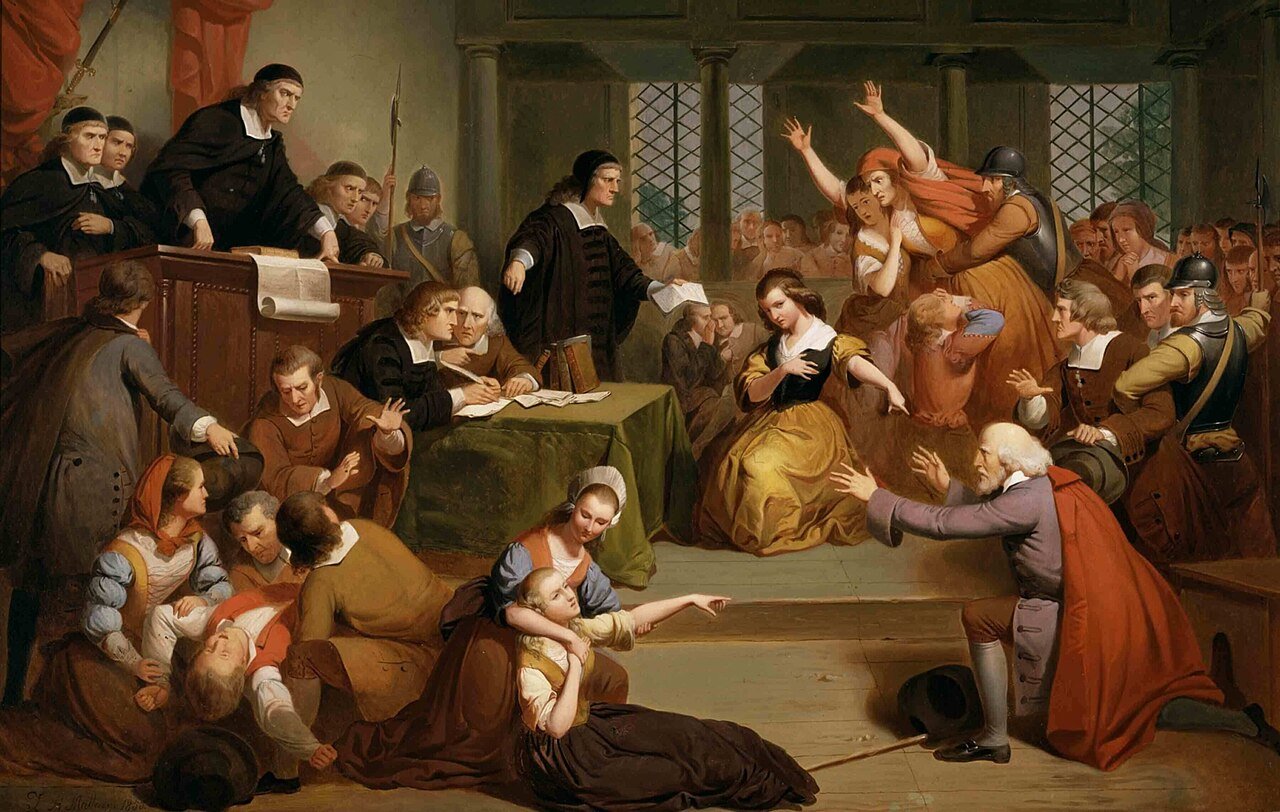
The Salem Witch Trials. In the winter of 1692, in the household of Salem Village's minister, two girls began to writhe, scream and accuse. Massachusetts was a Puritan colony primed for panic: a frontier war with the French and their Native allies raging to the north, a charter in legal limbo, smallpox in the towns, and a deep popular belief that the Devil was loose in New England. When the girls named their tormentors - beginning with the enslaved servant Tituba - the machinery of the law turned a village quarrel into a colony-wide catastrophe.
The Court of Oyer and Terminer convened in June 1692 and began to hang. Nineteen men and women were hanged on Gallows Hill over four months; the elderly Giles Corey, refusing to plead, was pressed to death under stones; several more died in jail. The court's fatal license was spectral evidence - testimony that the accused's spirit had attacked the afflicted - which no defense could answer, and the accusations climbed the social ladder from outcasts to prosperous church members, a minister, and the governor's wife.
In October 1692 Governor William Phips, his own wife now named, dissolved the court; a new court, forbidden spectral evidence, acquitted nearly everyone it tried. The colony spent the next generation repenting: a day of fasting in 1697, jurors' public apologies, the reversal of the convictions, and payments to the victims' families. Salem Village itself, renamed Danvers, never quite escaped its year of hangings.
Salem burned a permanent warning into American memory: the danger of accusation without evidence, of courts that accept what cannot be disproved, of panic dressed as piety. Its nineteen hanged are memorialized in stone at Salem, and its name has become the language's word for every persecution that outruns the truth - the witch-hunt.
 Britannica: Salem Witch Trials
Britannica: Giles Corey
Britannica: Sir William Phips