 Go Back

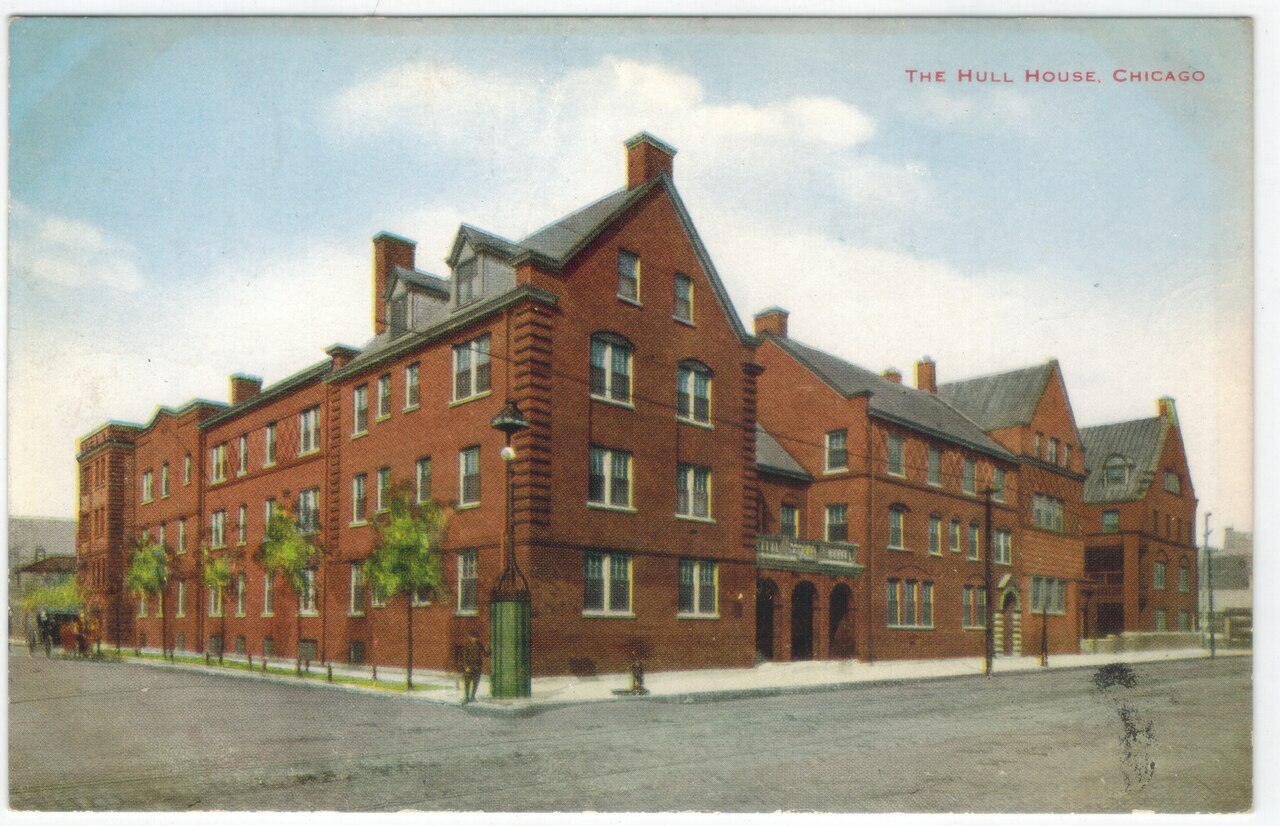
The settlement movement began when idealistic university graduates moved into poor city neighborhoods to live, learn, and help. The idea was born at Toynbee Hall, founded in London's East End in 1884, where university men resided in the community they served. On a visit to London, a young Illinois woman named Jane Addams saw Toynbee Hall and carried the model home. In 1889 she and Ellen Gates Starr rented an old mansion at 800 South Halsted Street in Chicago, built by Charles Hull in 1856, and opened Hull House, one of the first social settlements in North America.
Hull House grew into a complex of twelve buildings covering half a city block, with a kindergarten, classes, a gymnasium, and a playground. Residents taught English to immigrants, campaigned for safe pasteurized milk, cared for the children of working mothers, and studied the neighborhood systematically. Talented residents, including Florence Kelley, Julia Lathrop, and Alice Hamilton, carried its investigations into factories, workplaces, and city government.
Hundreds of imitators followed. Stanton Coit founded the Neighborhood Guild in New York, Robert A. Woods opened Andover House in Boston, and by the early 1900s settlements operated in cities across the country. Their residents pioneered a new profession, social work, based on living among the poor, gathering facts about their conditions, and pressing for labor laws, juvenile courts, and public health measures. Addams, who told the story in Twenty Years at Hull-House (1910), became the first woman president of the National Conference of Social Work.
By 1924 the settlement houses had changed how America responded to urban poverty. They showed that reform required residence, research, and legislation together, and they trained a generation of reformers who shaped state and federal policy. Addams herself extended her work to the cause of peace, presiding over the International Congress of Women in 1915, while the settlements continued as neighborhood centers in cities still crowded with newcomers.
 Britannica: Jane Addams
Britannica: Social Settlement
Britannica: Hull House