 Go Back

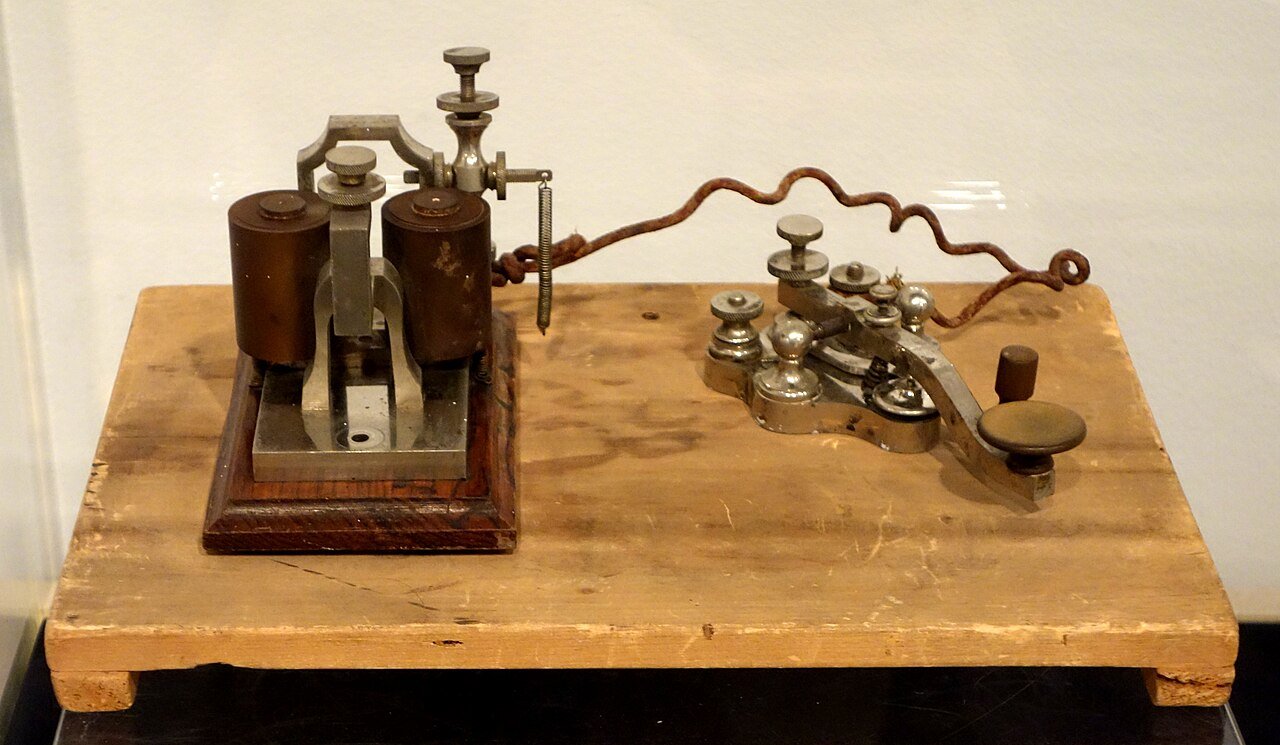
The Telegraph. On 24 May 1844, from the chamber of the Supreme Court in Washington, Samuel F.B. Morse tapped out to his partner in Baltimore four words chosen from the Book of Numbers: 'What hath God wrought.' The line - forty miles of wire on poles beside the Baltimore and Ohio railroad, built with a thirty-thousand-dollar congressional appropriation - was the first electrical telegraph in America, and the words announced a rupture in human history: for the first time, information could travel faster than a horse, a ship or a train.
The wire spread at railroad speed. By 1846 lines linked Washington to New York; by 1851 the overland network reached the Mississippi; by 1861 the transcontinental line to San Francisco killed the eighteen-month-old Pony Express in a stroke. Morse's code - the dot-dash alphabet he and his partner Alfred Vail devised - became the world's language of the wire, and the Associated Press, founded in 1846, reorganized the news itself around the telegraph's speed and its costs: the terse 'inverted pyramid' of modern journalism is the telegraph's child.
The wire remade everything it touched. Markets fused into one national market - the price of cotton in New York now meant the same in New Orleans the same day; railroads ran on telegraphed orders; the weather bureau's forecasts, the police's alarms, the battlefield's commands all moved at the speed of electricity. In the Civil War Lincoln lived in the War Department's telegraph office, running armies by wire; the war was the first directed by telegraph.
In 1858, and permanently in 1866, the cable crossed the Atlantic, and the world shrank again - the Victorian internet, one historian calls it. The telegraph was the first of the great breaks in the history of communication: the telephone, the radio, the internet all lengthen its line. 'What hath God wrought' is the founding text of the information age.
 Britannica: Samuel F.B. Morse
Britannica: Telegraph
Britannica: Associated Press