 Go Back

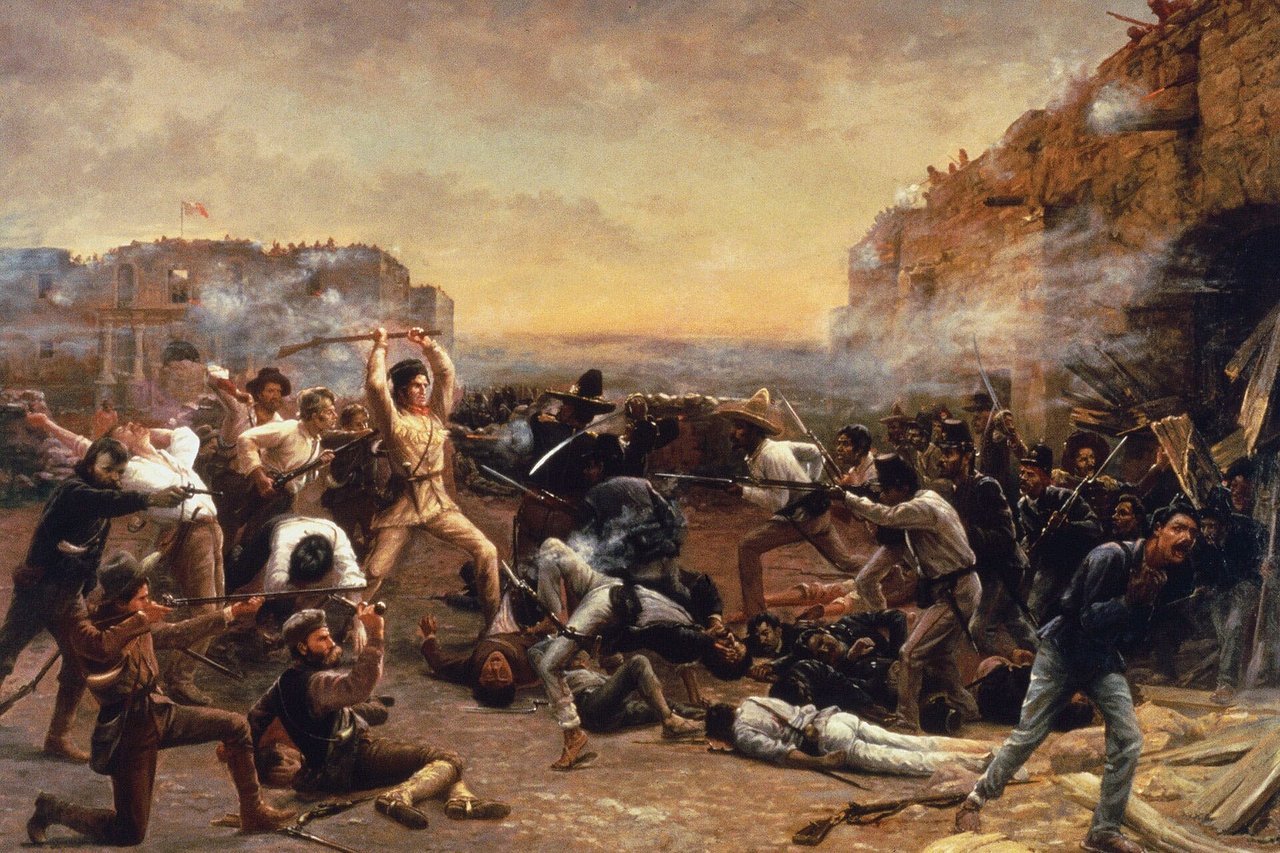
The Texas Revolution. Mexico opened its Texas province to American settlers in the 1820s, and by 1835 thirty thousand Anglo colonists - many of them slaveholders, few of them willing Catholics or Mexicans - far outnumbered the Tejanos. When Mexico's new strongman, General Antonio Lopez de Santa Anna, tore up the federal constitution and centralised power, the colonists rose, joined by Tejanos who wanted their old federalism back. In October 1835 the Texas Revolution began at Gonzales with a cannon and a defiant flag: COME AND TAKE IT.
The war's early deeds became American scripture. At the Alamo, a San Antonio mission-fort, some two hundred defenders under Travis, Bowie and Crockett held out for thirteen days and died to the last fighting man when Santa Anna stormed the walls on 6 March 1836; three weeks later, at Goliad, some four hundred Texan prisoners were massacred on Santa Anna's orders. 'Remember the Alamo! Remember Goliad!' ran the war cry of the retreat, the Runaway Scrape, as the settlements fled east before the Mexican army.
The reversal was as sudden as legend demands. On 21 April 1836, by the San Jacinto River, Sam Houston's army caught Santa Anna's camp at siesta and destroyed it in eighteen minutes; the general, captured next day in a private's uniform, signed away Texas. The Republic of Texas was born - the Lone Star Republic - unrecognized by Mexico, courted and kept at arm's length by an America wary of another slave state.
For nine years the republic stood alone: Houston as its president, Comanche raids on its frontier, debt in its treasury, and annexation as its constant ambition. In 1845 the United States admitted Texas as the twenty-eighth state, and Mexico's answer was war - the conflict that would deliver half of Mexico's territory into American hands. The Alamo, meanwhile, began its second life as the shrine of Texas identity and the most contested memory of the American West.
 Britannica: Texas Revolution
Britannica: Battle of the Alamo
Britannica: Battle of San Jacinto