 Go Back

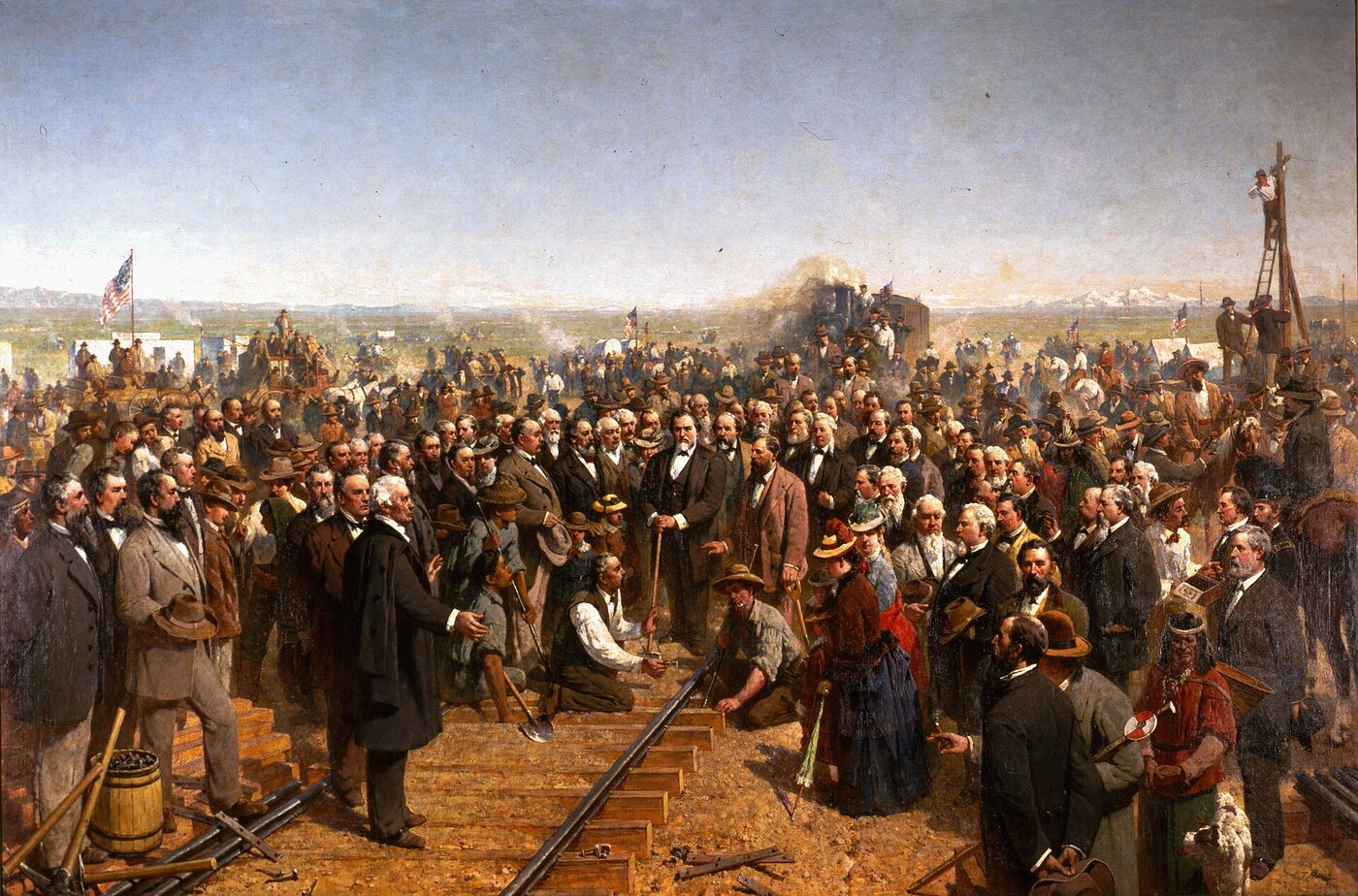
For decades Americans dreamed of a railroad binding the Pacific coast to the East. The Pacific Railway Acts of 1862 and 1864 made it a national project: the federal government chartered two companies, granted them enormous land subsidies along the route, and loaned them bonds for every mile of track. The Union Pacific built westward from Omaha, Nebraska, largely with Irish immigrants and Civil War veterans, while the Central Pacific, the creation of Sacramento merchants Leland Stanford, Collis Huntington, Mark Hopkins, and Charles Crocker, tackled the far harder task eastward over the Sierra Nevada.
The Central Pacific's workforce became mostly Chinese. Skeptical at first, Crocker hired Chinese laborers in 1865, and they proved so capable that the company recruited them by the thousands, eventually about twelve thousand men, some ninety percent of its workforce. They bored fifteen tunnels through Sierra granite with hand drills and black-powder blasting, one of the most dangerous jobs on the line, and endured avalanches that buried entire camps. They were paid less than white workers and had to buy their own food and lodging. In June 1867 several thousand Chinese tracklayers struck for higher pay and shorter hours, a remarkable act of labor solidarity that Crocker broke by cutting off their food supplies.
On May 10, 1869, the two lines met at Promontory Summit, Utah, where Leland Stanford drove a ceremonial golden spike and telegraph wires carried the news to a celebrating nation. A journey from New York to San Francisco that had taken months by sea or wagon now took about a week. The Chinese workers who made it possible were pointedly absent from the famous photographs, and within a generation the country they had helped bind together barred their countrymen, as the Chinese Exclusion page recounts.
The railroads transformed the West: they carried settlers, cattle, wheat, and minerals to market, created national networks of time and trade, and made the railroad corporations the nation's first big businesses, with the corruption to match, including the Credit Mobilier scandal that reached Congress in 1872. By 1900 five transcontinental lines crossed the country. The project stands as both an engineering triumph and a parable of the era: public generosity, private fortune, and immigrant labor whose contribution was long written out of the story.
 Britannica: Transcontinental Railroad
 National Park Service: Golden Spike National Historical Park
 Library of Congress: Railroad Maps, 1828 to 1900