 Go Back

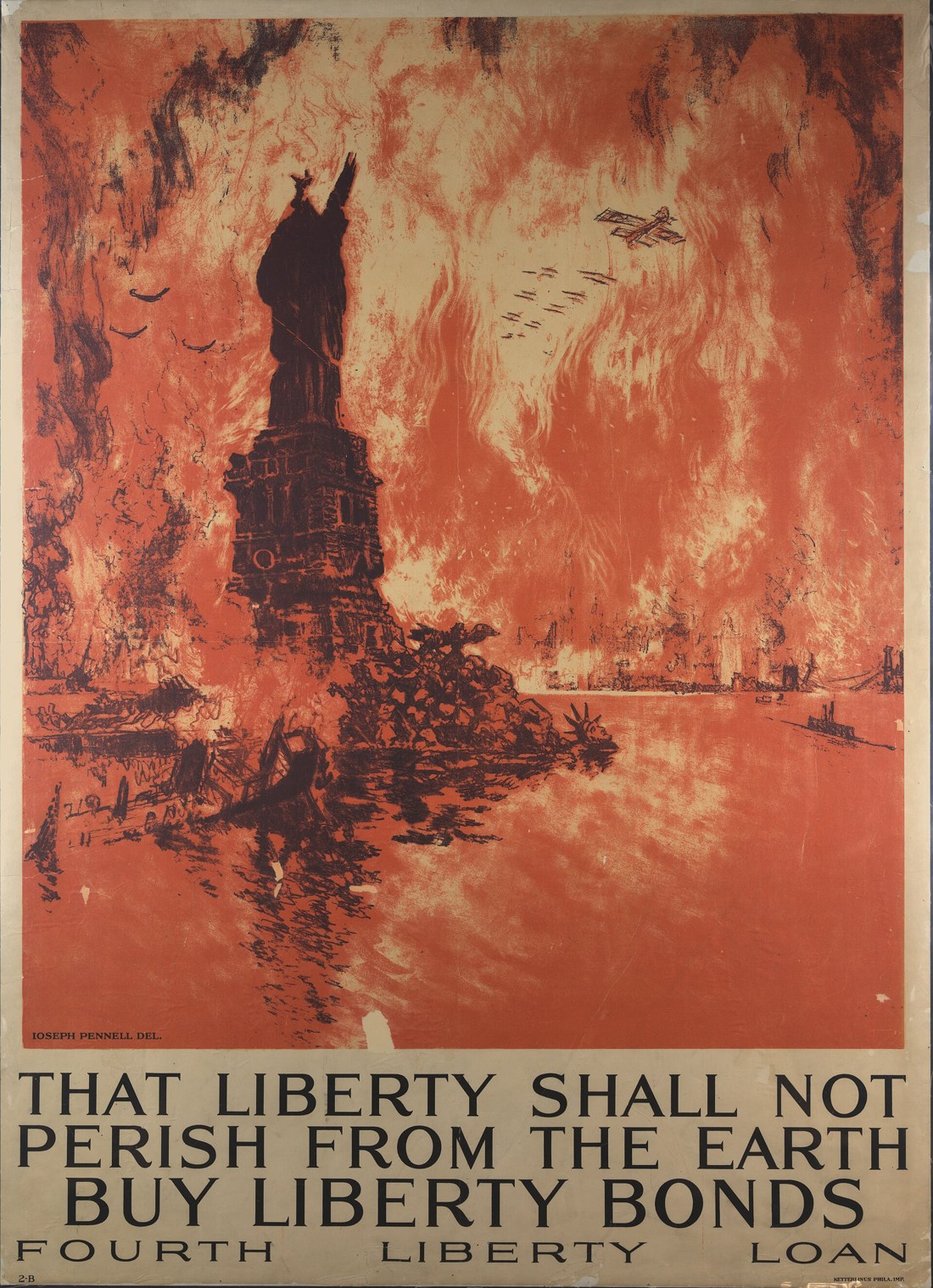
When war engulfed Europe in August 1914, President Woodrow Wilson proclaimed American neutrality, and most Americans were glad to stay out. But the economy boomed supplying the Allies, and German submarine warfare steadily poisoned relations. The sinking of the liner Lusitania in 1915 killed 128 Americans. At the end of January 1917, Germany announced it would resume unrestricted submarine attacks on all shipping, and British intelligence handed Washington the Zimmermann Telegram, in which Germany promised Mexico the recovery of Texas, New Mexico, and Arizona if it joined the war. On April 6, 1917, Congress declared war on Germany.
The United States was hardly ready. Its small regular army had to be expanded into a mass force through the Selective Service draft, which registered millions of men. Under General John J. Pershing, the American Expeditionary Forces crossed the Atlantic in growing numbers, the first troops reaching France in June 1917. Pershing insisted his soldiers fight as an independent American army rather than as replacements in Allied units.
American weight proved decisive in 1918. Fresh US divisions helped stop the great German spring offensives, then took the lead in the Allied counterattack, clearing the St.-Mihiel salient in September and grinding through the Meuse-Argonne, the largest battle in American history to that time. Exhausted and blockaded, Germany signed the armistice on November 11, 1918. American deaths numbered about 116,000, more than half of them to disease, above all the influenza pandemic.
The war transformed the United States. It became the world's leading creditor nation, its government briefly managed the economy on an unprecedented scale, and its president dominated the peace conference that followed. Yet the country also turned inward: the Senate rejected the peace treaty Wilson brought home, and by 1924 America had refused to join the League of Nations it had helped design.
 Office of the Historian: American Entry into World War I, 1917
 Britannica: World War I