 Go Back

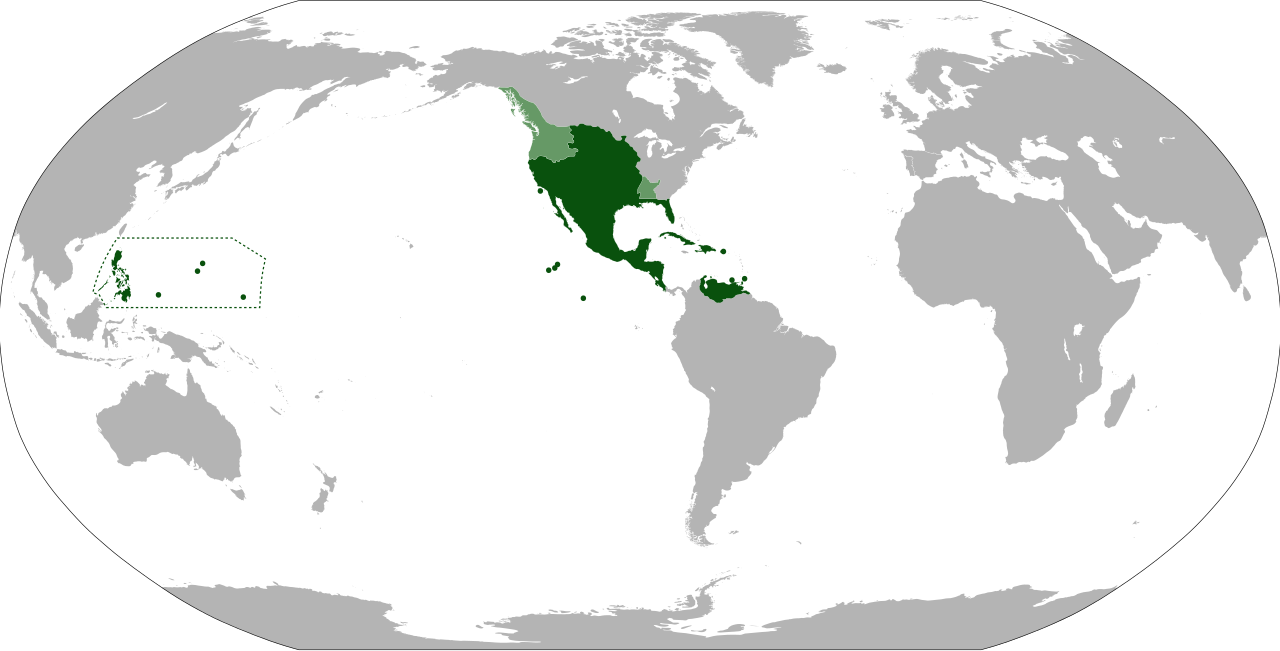
The Viceroyalty of New Spain. The Viceroyalty of New Spain was the first of the four viceroyalties that Spain created to govern its conquered lands in the New World. Established in 1535, fourteen years after the fall of Tenochtitlan, it initially embraced all Spanish-controlled land north of the Isthmus of Panama, and later grew to take in upper and lower California, the future southwestern United States, the Gulf coast eastward to Florida, Spain's Caribbean possessions, and from 1565 even the newly conquered Philippines. Administered from Mexico City for three centuries, this administration matters deeply because it was the first great template of Spanish rule in the Americas, integrating the hemisphere into global commerce through an economy based almost entirely on mining and ranching, while its viceroys sponsored the conversion of the Native population to Christianity and built an array of educational institutions.
The viceroy, appointed by the Spanish Crown, was technically the supreme authority, yet in practice the considerable independence of governors and royal audiencias in the subordinate regions confined his real power largely to central and southern Mexico. The first viceroy, Antonio de Mendoza, who ruled from 1535 to 1549, dispatched Francisco Coronado on his expedition northward while ameliorating some of the worst abuses of the conquistadores and supporting the church's work with the Native population. That mission came at a terrible cost: during the first hundred years of Spanish rule, the Indigenous population of New Spain collapsed from an estimated 25 million to 1 million through maltreatment, disease, and the disruption of their cultures, while a casta hierarchy - famously catalogued in the viceroyalty's paintings - stratified society by ancestry. After a period of decline in the late seventeenth century, distinguished viceroys such as Bucareli and Revillagigedo revived the administration and pushed settlement overland into California to counter Russian and British interest; the viceroyalty weathered the early independence risings of Hidalgo and Morelos, only to succumb to Agustin de Iturbide's coalition in 1821.
 Britannica: Viceroyalty of New Spain
 World History Encyclopedia: Viceroyalty of New Spain, c. 1800
 Humanities LibreTexts: 2.1.1: New Spain, an introduction
 Smarthistory: Viceroyalty of New Spain