 Go Back

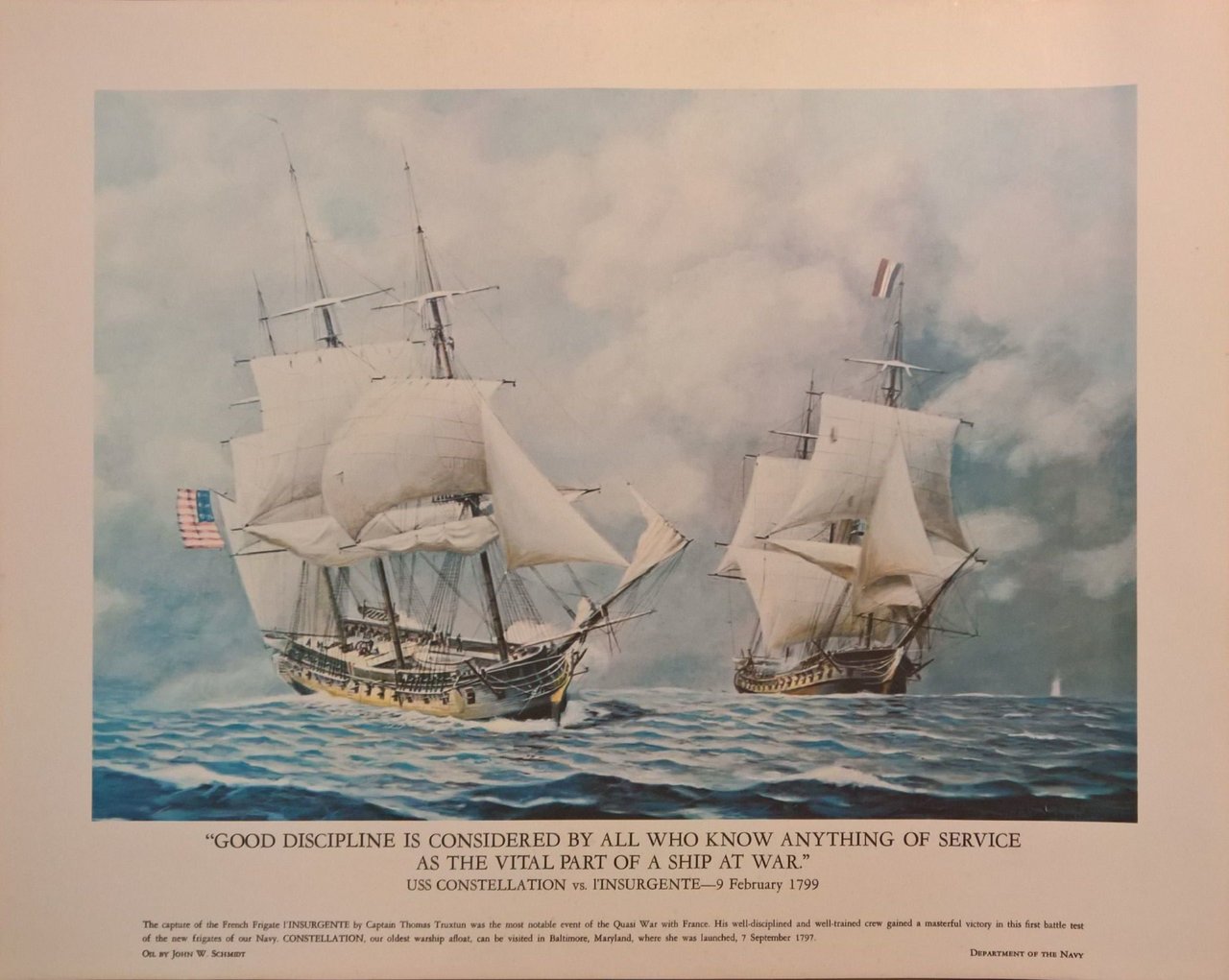
The XYZ Affair and the Quasi-War. Revolutionary France, furious that America had made a treaty with Britain in 1795, began seizing American merchant ships in the Caribbean, and President Adams sent three envoys to Paris to make peace. There they were met not by the foreign minister Talleyrand but by his intermediaries - named X, Y and Z in the American dispatches - with a demand: pay a large bribe, and lend France millions, before negotiations could even begin.
When Congress published the dispatches in 1798, America exploded. 'Millions for defense, but not one cent for tribute' became the cry of the hour; Federalists and war fever rose together; Congress raised an army, created the Navy Department, and canceled the old French alliance. Jefferson's Republicans, defenders of France, were cast as traitors - the politics of the Alien and Sedition Acts were born in this fever.
The war that followed was never declared. For two and a half years American and French warships fought an undeclared naval war - the Quasi-War - in the Caribbean: frigates like the Constellation, which beat the French frigate L'Insurgente and battered La Vengeance, convoyed merchantmen and swept the sea-lanes, while the new American navy proved it could stand against a great power's cruisers.
Adams, to his party's fury, chose peace. Sending new envoys to France, he ended the crisis in the Convention of 1800: Napoleon, busy with Europe, released the alliance and the claims. It cost Adams the Federalists and arguably the presidency, and he counted it his finest act - his epitaph, he said, should record only that he 'took upon himself the responsibility of the peace with France.' The Quasi-War gave the republic its navy, its first war fever, and its first proof that a president could stop a war his own party wanted.
 Office of the Historian: The XYZ Affair and the Quasi-War with France, 1798-1800
 Britannica: XYZ Affair
Britannica: John Adams