 Go Back

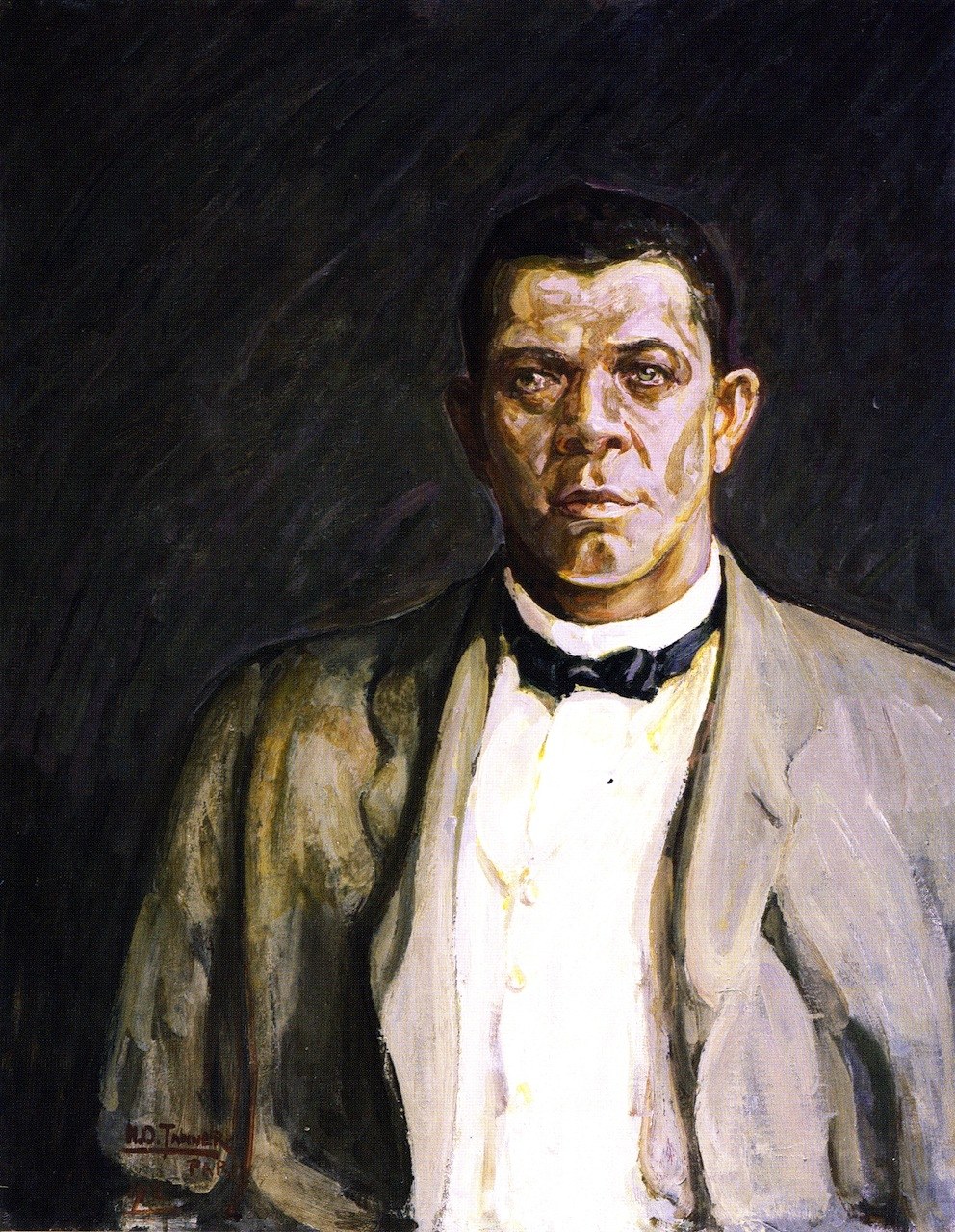
When Reconstruction ended in 1877, the federal government stopped protecting the rights of formerly enslaved people in the South. Poll taxes, literacy tests, and violence stripped most Black Southerners of the vote, and Jim Crow laws imposed rigid segregation in schools, trains, and public places. In this harsh world, two Black leaders offered very different strategies for advancement. Booker T. Washington, born enslaved in Virginia in 1856, worked in salt furnaces and coal mines as a boy before making his way to Virginia's Hampton Normal and Agricultural Institute in 1872, where he worked as a janitor to pay his expenses. In 1881 he was chosen to lead a new school for Black students at Tuskegee, Alabama, which he built from two small converted buildings into the Tuskegee Normal and Industrial Institute.
Washington argued that Black Americans should first win economic security through vocational training, farming, and property ownership, trusting that prosperity would earn civil rights later. He summarized this approach at the Atlanta Exposition on September 18, 1895, telling a racially mixed audience, "In all things that are purely social we can be as separate as the fingers, yet one as the hand in all things essential to mutual progress." White politicians and wealthy industrialists made him their preferred Black spokesman, and his autobiography Up from Slavery (1901) made him internationally famous. Critics called his position the Atlanta Compromise and warned that it accepted second-class citizenship.
W.E.B. Du Bois came to the opposite conclusion. Born free in Great Barrington, Massachusetts, in 1868, he graduated from Fisk University in 1888 and in 1895 became the first Black person to earn a Ph.D. from Harvard University. In The Souls of Black Folk (1903), he charged that Washington's program asked Black people to surrender political power, civil rights, and higher education, and he argued for developing a "Talented Tenth" of college-trained Black leaders. In 1905 he helped organize the Niagara Movement for open protest, and in 1909 he cofounded the National Association for the Advancement of Colored People (NAACP), editing its magazine, The Crisis, from its founding in 1910.
The Washington-Du Bois debate set the terms of Black public life for a generation. Tuskegee trained thousands of teachers and farmers and became the model for Black industrial education, while the NAACP fought lynching and segregation in the courts and the press. By the early 1920s Du Bois was also linking the struggle of Black Americans to peoples of African descent worldwide through the Pan-African Congresses. Although the two men disagreed bitterly, together they built the institutions, Black colleges and a national civil rights organization, that carried the fight for equality forward.
 Britannica: Booker T. Washington
Britannica: W.E.B. Du Bois
Britannica: Atlanta Compromise