 Go Back

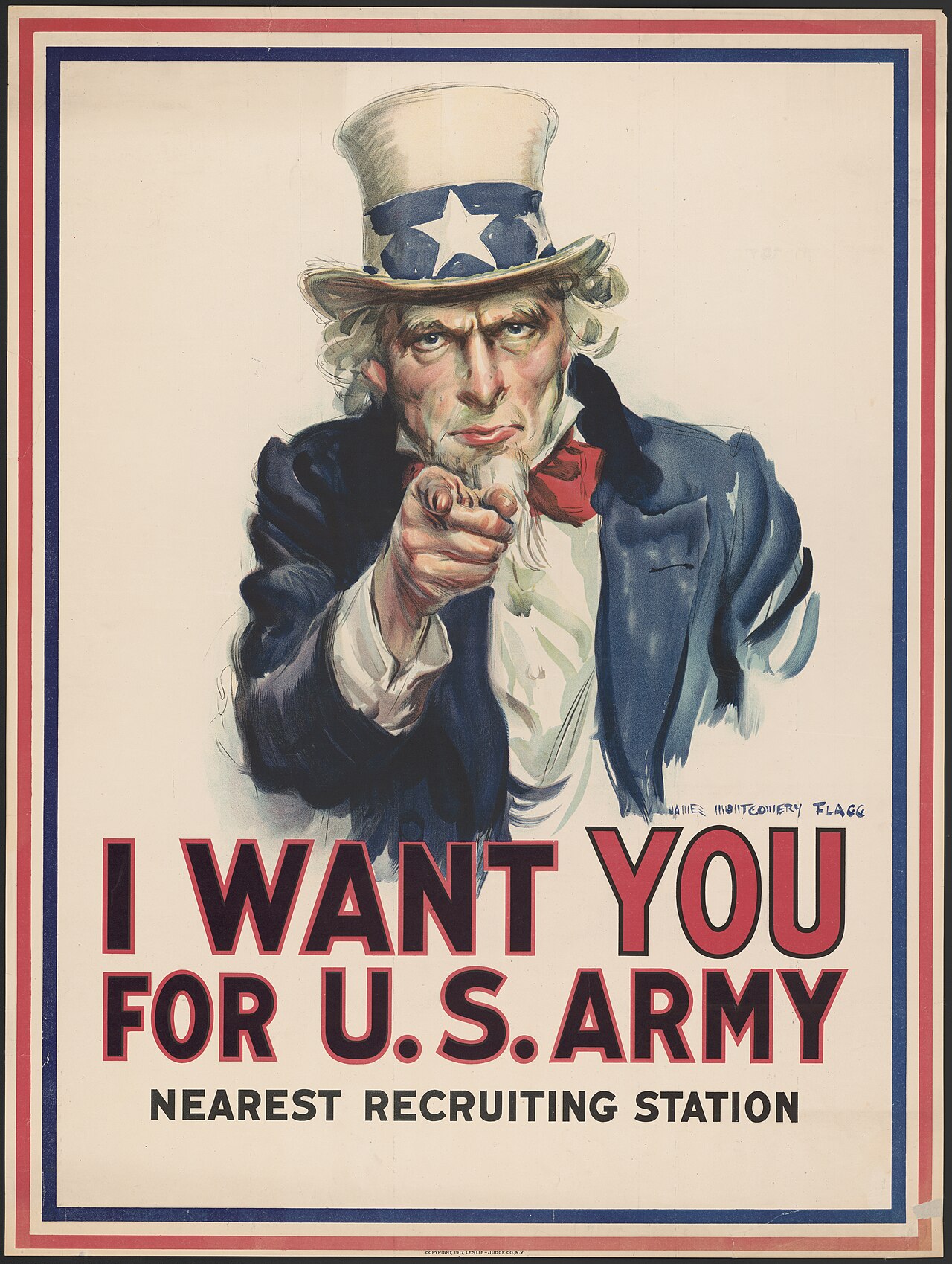
To fight its first modern total war, the United States mobilized its entire society in 1917-1918. A Selective Service draft raised an army of millions; the War Industries Board directed factories; the Food Administration under Herbert Hoover urged voluntary conservation with slogans like 'wheatless' and 'meatless' days; and massive Liberty Loan drives sold war bonds to ordinary citizens. The Committee on Public Information, the government's propaganda agency, flooded the country with posters, films, and speeches demanding unity.
That unity had a coercive edge. German Americans faced suspicion, boycotts, and violence; schools dropped German language teaching; and the government demanded absolute loyalty. Congress wrote the demand into law with the Espionage Act of June 1917, which made it a crime to make false statements harming the war effort or to obstruct recruiting, and the Sedition Act of 1918, which went further and outlawed 'disloyal' speech about the government, the flag, or the uniform.
Nearly two thousand people were prosecuted under these laws. Socialist leader Eugene V. Debs was sentenced to ten years in prison for an antiwar speech. Charles Schenck, a Socialist Party official who mailed some 15,000 leaflets urging draftees to resist, appealed his conviction to the Supreme Court. On March 3, 1919, the Court unanimously upheld it; Justice Oliver Wendell Holmes wrote that speech creating a 'clear and present danger' was not protected by the First Amendment.
When the war ended, the machinery of loyalty was turned on radicals, feeding the Red Scare of 1919-1920. The Sedition Act was repealed in 1920, and Debs was freed in 1921, but the Espionage Act remained on the books. The wartime experience left a lasting American argument, still unsettled in 1924, over where national security ends and free speech begins.
 Britannica: Espionage Act
Britannica: Schenck v. United States
Britannica: Sedition Act