 Go Back

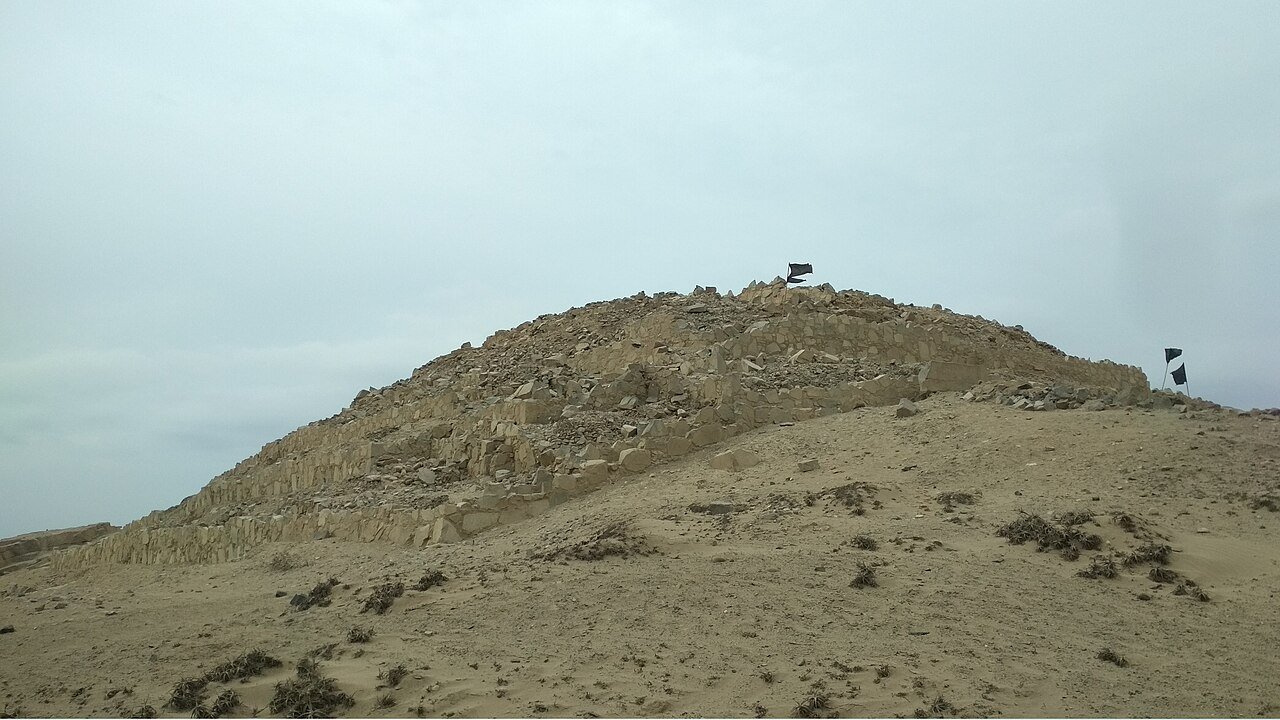
El Paraiso. A few miles from the mouth of the Chillon River, just north of modern Lima, stands the largest monument of the age before pottery on the coast of Peru: El Paraiso, a complex of massive stone-and-adobe platforms raised around 1800 BC. It belongs to the same astonishing world as Caral, the Preceramic period, when the people of the Peruvian coast - living on fish from the cold current and cotton from the river valleys - built some of the earliest monumental architecture in the Americas centuries before they fired a pot.
The site covers more than fifty hectares, with a dozen mounds arranged around a central plaza, the largest structures standing over ten meters high. Its builders worked without metal, wheels or beasts of burden: the platforms were raised from hundreds of thousands of tons of quarried stone and adobe, carried in woven shicra bags and laid with clay mortar, then plastered and painted in vivid reds and yellows. Within the main temple, archaeologists uncovered the remains of painted friezes - and, in later levels, the haunting image of a figure with upraised arms.
What El Paraiso was for is still argued. It had few signs of permanent residence: no dense middens, no houses on the scale of the platforms. Most scholars read it as a ceremonial and pilgrimage center, a meeting place where the fishing villages and farming hamlets of the lower Chillon gathered for rites and feasts - a pattern, temple first and city later, that would recur along the Peruvian coast for three thousand years.
El Paraiso was abandoned around the time pottery transformed Andean life, and the desert preserved it almost intact for four thousand years. It now lies within the growing outskirts of Lima, threatened and protected in turn, and stands with Caral as testimony that civilization in the Americas began not with farms and pots, but with fish, cotton - and the impulse to build together.
 Encyclopedia.com: Caral
 UNESCO: Sacred City of Caral-Supe