 Go Back

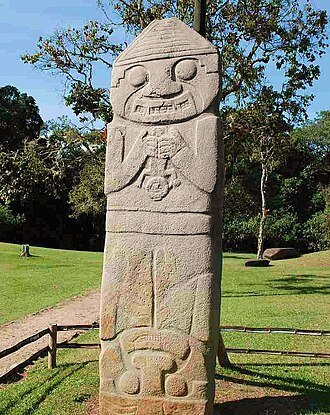
San Agustin. In the high green valleys of the Upper Magdalena River, in what is now southern Colombia, a vanished people raised the greatest concentration of stone monuments in South America. Between about the first and the eighth centuries AD, the builders of San Agustin carved hundreds of colossal statues from volcanic rock - gods and guardians, warriors and mothers, jaguars, eagles and frogs - and set them over the tombs of their dead, beside temples and along the banks of the river whose source they revered.
The statues are like nothing else in the Americas: slab-faced figures with staring eyes and bared fangs, some towering over seven meters, many carved with alter egos - a human figure crowned by a jaguar or bird-spirit - that scholars read as images of shamans and their transformations. The tombs they guarded were stone chambers under earthen mounds, and near them the San Agustin people shaped the landscape itself: ceremonial platforms, causeways, and the extraordinary carved stream-bed of Lavapatas, where figures and channels were cut into the living rock of the river.
Of the builders themselves little is known directly. They were farmers of maize and beans, goldsmiths of skill, and traders on the routes between the Andes and the Amazon, and their society could command the labor to quarry, transport and raise stones weighing tons. They had no writing and left no name; even their language is lost. When their culture faded, around the eighth or ninth century, the forest covered the mounds, and local peoples who followed knew the statues only as the work of the ancients.
The tombs were brought back to light from the eighteenth century onward - and plundered grievously before archaeologists could protect them. Today the San Agustin Archaeological Park and its sister sites preserve the largest group of religious monuments and megalithic sculptures in South America, a UNESCO World Heritage Site since 1995, and the emblem of Colombia's pre-Columbian past.
 UNESCO: San Agustin Archaeological Park
 World History Encyclopedia: The Megalithic Funerary Art of San Agustin