 Go Back

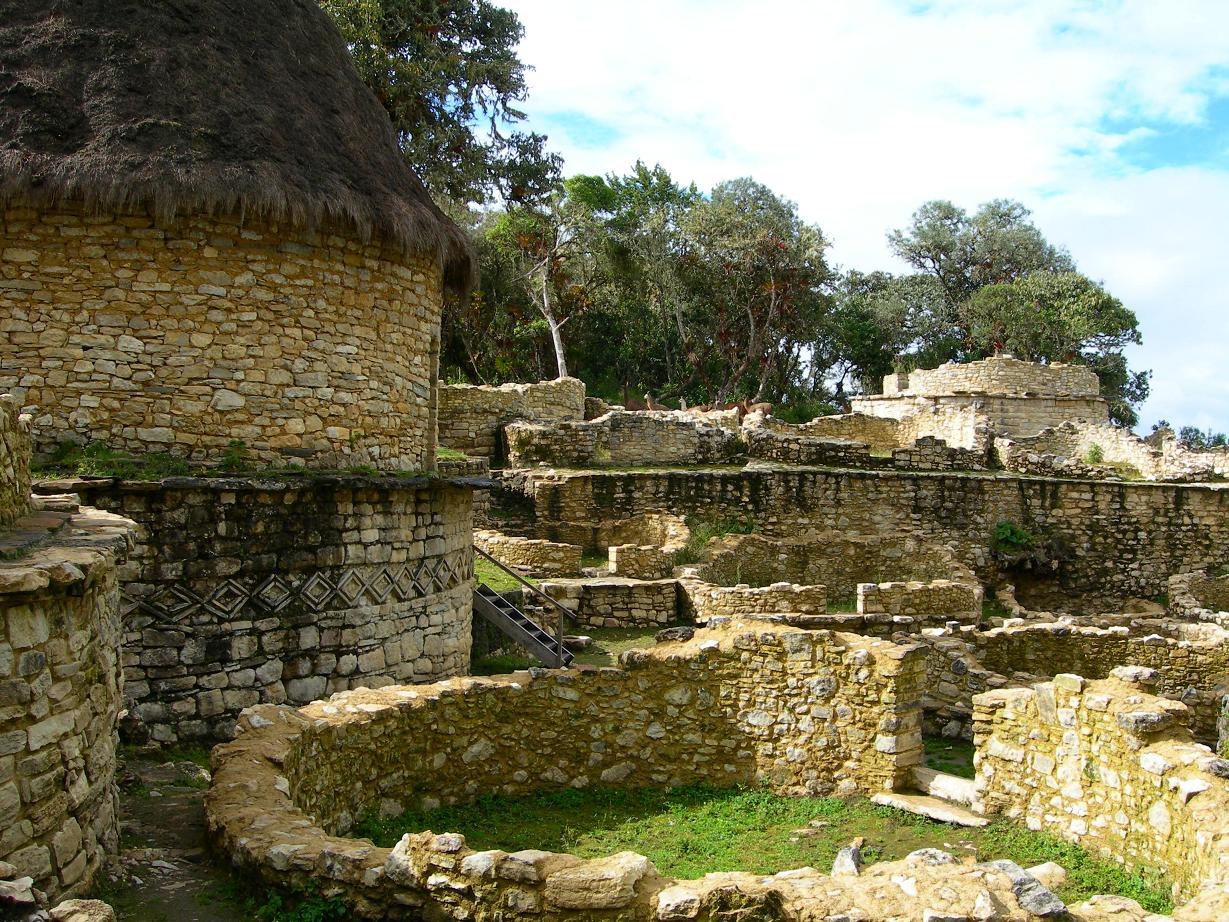
The Chachapoya, called the Warriors of the Clouds by the Inca, built some of the most spectacular cities in the Americas on misty mountaintops in northern Peru. Their homeland lay in the cloud forests of the eastern Andes, where ridges rise above the Utcubamba River valley and rain feeds dense forests draped in orchids and bromeliads. From about 800 CE, Chachapoya communities constructed settlements of circular stone houses decorated with geometric friezes in zigzag and diamond patterns, a style found nowhere else in the Andes.
The greatest Chachapoya monument is Kuélap, a walled fortress-city perched on a limestone ridge at three thousand meters. Its outer wall rises up to twenty meters high and stretches for hundreds of meters, pierced by only three narrow entrance passages that funnel into steep ramps, easy to defend. Inside, more than four hundred circular buildings housed a population of several thousand. Kuélap was once thought to be purely a fortress, but archaeologists now see it as a political and ceremonial center for the surrounding region, occupied for centuries and remodeled many times.
Chachapoya society was organized in local chiefdoms rather than a single kingdom, and the cloud forest peoples farmed terraced fields of maize, potatoes, and beans, raised llamas, and traded with the coast and the Amazon lowlands. They buried their dead in spectacular fashion, placing mummies in chullpas, small burial houses built into cliff faces, and in the famous sarcophagi of Karajía, two-meter-tall clay figures perched on a cliff ledge that once held mummy bundles. Spanish chroniclers later described the Chachapoya as tall and fair-skinned, giving rise to fanciful legends of lost European tribes, but archaeology shows they were a local Andean people.
In the 1470s the Inca emperor Topa Inca Yupanqui conquered the Chachapoya after hard fighting, deporting many thousands under the Inca resettlement system. When the Spanish arrived decades later, some Chachapoya allied with them against the Inca, and the region became a base for early Spanish expeditions toward the Amazon. Kuélap, once known as the Machu Picchu of the north, is now a major archaeological park reached by cable car, and ongoing excavations continue to reveal the sophistication of this cloud-forest civilization.
 UNESCO World Heritage Centre: The Great Settlement of Kuélap
 Wikipedia: Kuélap
 Peru Travel (PROMPERÚ): Kuélap Fortress
 Archaeology (Archaeological Institute of America): Chachapoya discoveries