 Go Back

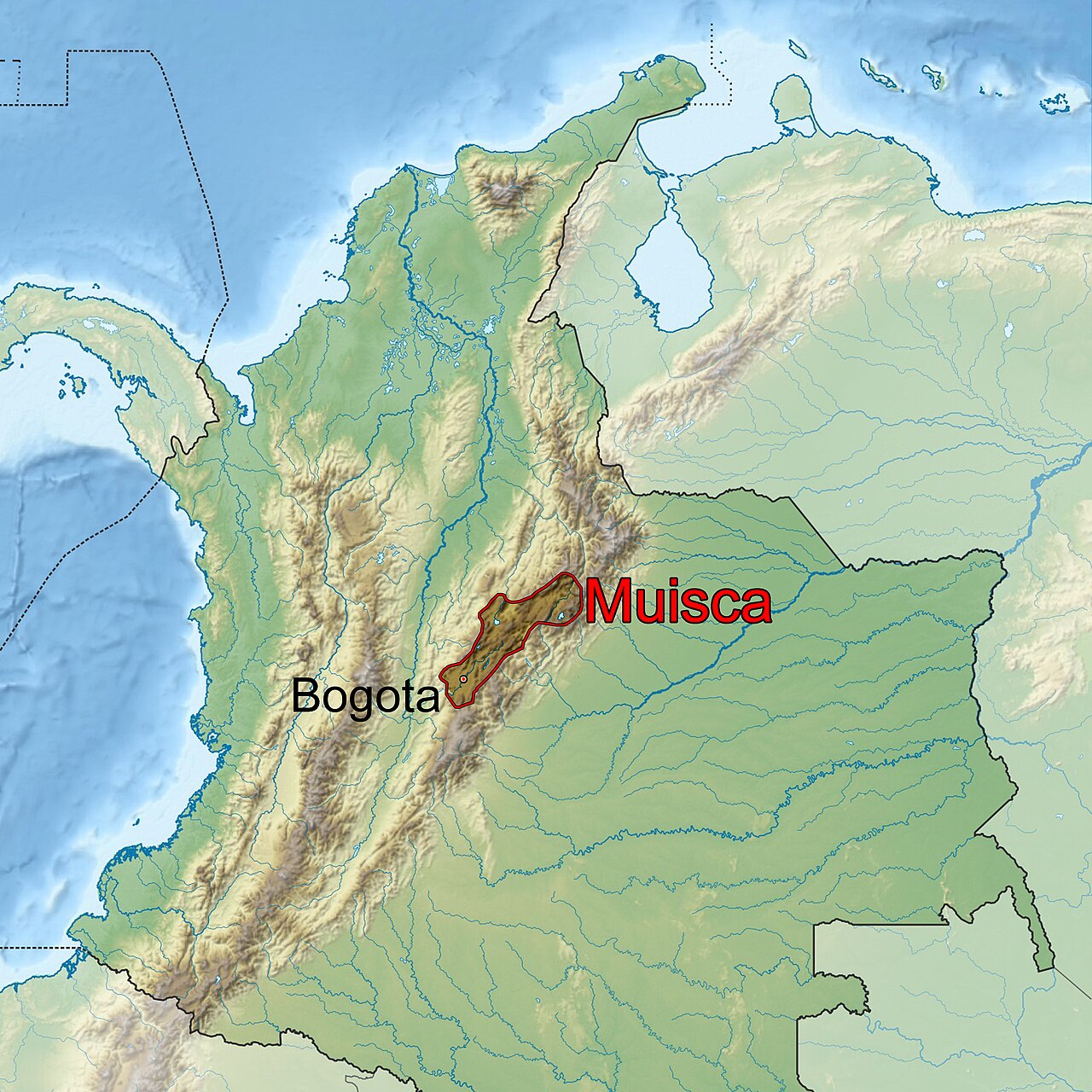
The Muisca Confederation. The Muisca civilization flourished in the fertile eastern highlands of what is now Colombia between 600 and 1600 CE, its territory encompassing modern Bogota and its environs, and it has gained lasting fame as the origin of the legend of El Dorado - 'The Gilded One'. A Muisca ceremony held at Lake Guatavita - actually only one of many kinds - involved a ruler being covered in gold dust; the Spanish, hearing this story, allowed their imagination and lust for gold to leap beyond the bounds of reality, and soon a legend arose of a magnificent golden kingdom. This confederation matters because its goldwork is among the great artistic traditions of the Americas: for the Muisca, gold was not used as a currency but as an artistic medium, mined from exposed veins and panned from mountain rivers.
The Muisca goldsmiths employed a wide range of techniques - lost-wax casting, a two-tone finish, repousse, soldering, granulation, and filigree - and hammered gold into thin sheets on round stone anvils. Their tunjos - small votive figures of snakes and flat male, female, and animal forms in gold alloy - were placed at sacred sites, and elite members of society wore pectorals, earrings, and nose studs. Nor did they restrict their art to gold: they created fine textiles of wool or cotton. There is ample evidence that commodities such as gold, shells, feathers, animal skins, tobacco, salt, and coca leaves moved through Muisca markets in a thriving regional trade. When the Spanish arrived in the 1530s, drawn by the very legend the Muisca had inspired, this rich highland world was drawn into the colonial age.
 World History Encyclopedia: Muisca Civilization
 Humanities LibreTexts: 4.4.2: Muisca Raft
 The Metropolitan Museum of Art: Northern Andes, 1400–1600 A.D.
 Smarthistory: Muisca Raft