 Go Back

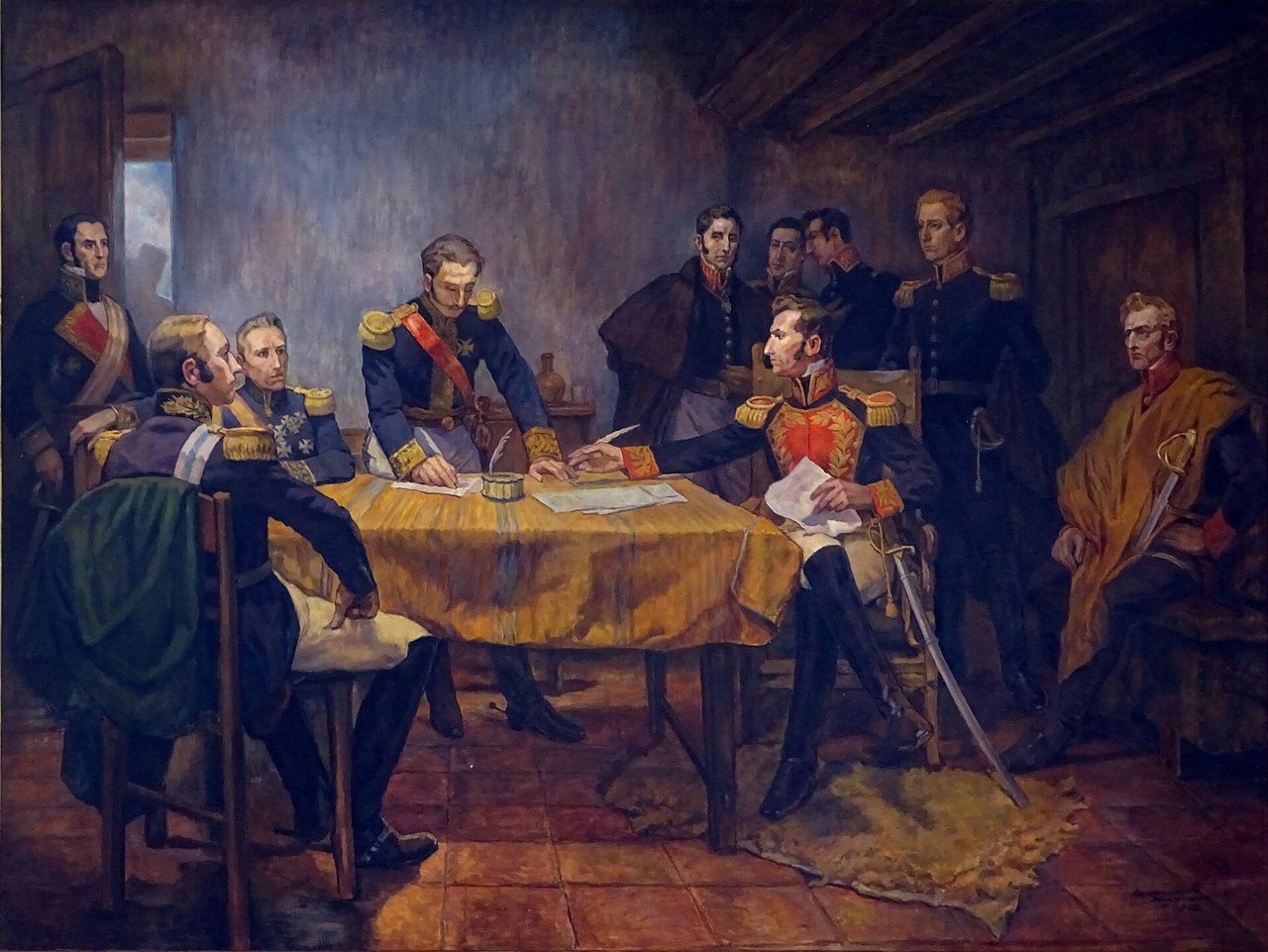
Ayacucho. By 1824 the Spanish Empire in America had shrunk to its birthplace and its fortress: Peru, where the last viceroy still ruled from the highlands with the last royalist army. Bolivar, now Dictator of Peru, drove the war into the mountains. At Junin, on 6 August 1824, his cavalry broke the royalist horse in a charge fought with lance and saber alone - not a shot fired - and the initiative passed forever to the patriots.
The decision came four months later on the plateau of Ayacucho, three thousand meters up in the Andes. On 9 December 1824 the royalist army under Viceroy Jose de la Serna, some nine thousand veterans with the best generals Spain had left, attacked the patriot army under Bolivar's lieutenant Antonio Jose de Sucre. The battle lasted an hour. Sucre's timing was perfect: the royalist advance overreached, the patriot counterstroke broke their center, and by afternoon the viceroy was a prisoner and his army was surrendering on terms.
The Capitulation of Ayacucho was more than a surrender: La Serna gave up not only his army but the war - the whole of Peru, every garrison, and the royal cause in South America. The last holdout, the fortress of Callao, starved into 1826; Upper Peru, liberated by Sucre, became the republic of Bolivia in August 1825, taking its name from Bolivar and its first constitution from his pen.
Ayacucho ended three hundred years of Spanish rule on the South American mainland. Spain kept only the islands of Cuba and Puerto Rico, and the marble of its American empire had become nine republics. Sucre, the Grand Marshal of Ayacucho at thirty-one, went on to be Bolivia's first president and to die by an assassin's bullet at thirty-five; the plain where he won is marked by a white obelisk, and Ayacucho remains, with Yorktown and Waterloo, one of the battles that closed an age.
 Britannica: Battle of Ayacucho
Britannica: Antonio Jose de Sucre
Britannica: Bolivia - Foundation and National Identity