 Go Back

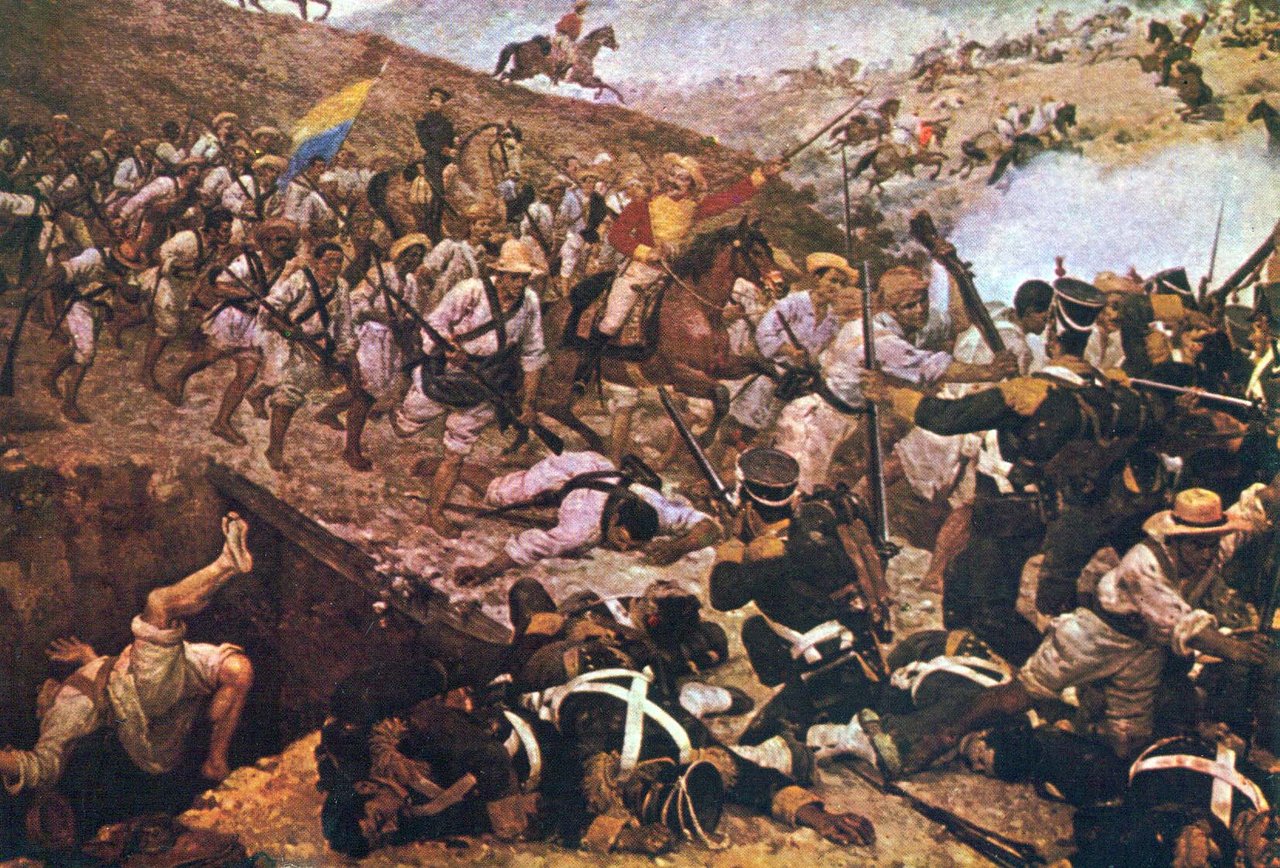
Bolivar and the Liberation of the North. Simon Bolivar was a young Caracas aristocrat - rich, brilliant, educated in Spain, and sworn, he said, on the Monte Sacro in Rome in 1805 not to rest until America was free. When Venezuela rose in 1810 he was its colonel and its propagandist; when the First Republic fell and the royalists under the terrible llanero chief Boves drowned the Second in blood, Bolivar was driven into exile in Jamaica, where he wrote the Jamaica Letter of 1815, the prophecy of the American continent's destiny. He would be called, and called himself, the Liberator.
His war was lost many times before it was won. Landing again in 1816, beaten again, driven to the Orinoco's edge, Bolivar rebuilt his cause in the plains: he raised the llanero horsemen who had destroyed his republics, welded them to the British Legion - five thousand veterans of Napoleon's wars who crossed the Atlantic to fight for him - and in 1819 attempted the impossible: he marched his army west through the flooded plains and over the frozen passes of the Andes, an ordeal that killed a third of his men, and fell upon the astonished royalists at Boyaca on 7 August 1819. New Granada was freed in a day.
From Boyaca ran the chain of victories that freed the north: Carabobo in 1821, which secured Venezuela; Pichincha in 1822 under Sucre, which freed Quito; and the creation of Gran Colombia - Venezuela, Colombia and Ecuador in one republic, with Bolivar as president. In 1824 his armies ended Spanish power in Peru itself at Junin and Ayacucho, and the liberated Upper Peru took his name: Bolivia.
The union did not survive the peace. The vast republic strained apart under its jealousies; Bolivar's authoritarian constitution of 1828 and his lifelong presidency alienated his own generals; Venezuela and Ecuador seceded as he lay dying. In December 1830, on his way to exile, the Liberator died at Santa Marta, poor and embittered: he who has served a revolution, he wrote, ploughs the sea. Within a generation he was the hero of the whole hemisphere, and his dream of American unity has haunted its politics ever since.
 Britannica: Simon Bolivar
Britannica: Battle of Boyaca
 Banrepcultural: Simon Bolivar