 Go Back

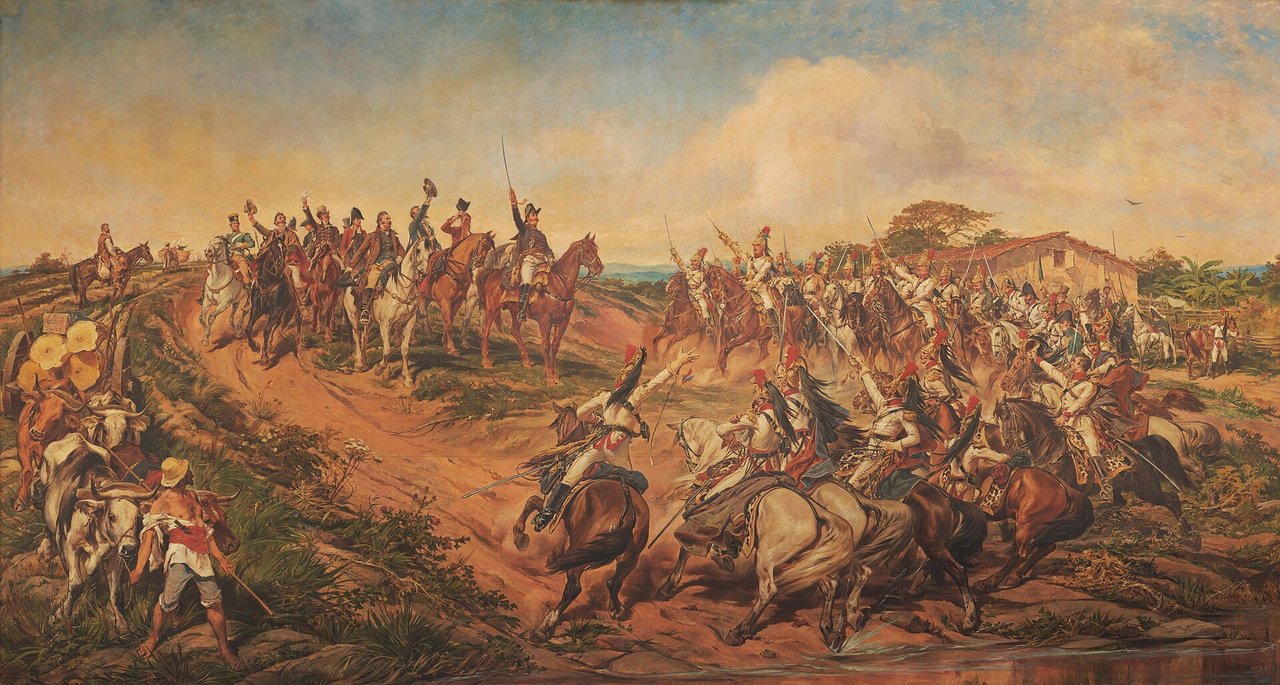
The Independence of Brazil. Brazil won its independence without a war of liberation, because its king was already there. In 1808 the Portuguese court, fleeing Napoleon, sailed to Rio de Janeiro under British escort - the first European monarchs to set foot in the Americas - and raised the colony to a kingdom in 1815. When King Joao VI was called home in 1821, he left his son Pedro as regent with famous advice: if Brazil must go, let it go with you, not with the rabble of the provinces.
The Lisbon Cortes forced the issue. Determined to reduce Brazil to a colony again, it ordered the prince home and the provinces to obey Lisbon directly. Pedro refused: in January 1822 the Fico - I am staying - and through the year the Brazilians rallied to him. On 7 September 1822, on the banks of the Ipiranga brook, he drew his sword and cried: Independence or death! The Grito do Ipiranga made Brazil independent; on 1 December he was crowned Emperor Pedro I. The provinces that resisted - Bahia, Para - were subdued by sea within two years by the hired British admiral Lord Cochrane, and Portugal itself recognized the empire in 1825.
Pedro I's Brazil was an anomaly the Liberator envied: a constitutional monarchy that kept its unity, its territory and its peace while Spanish America shattered. But the emperor ruled by fiat and favorites, lost the Banda Oriental - Cisplatina - to war and independence in 1828, and quarreled with his Brazilian party over absolutism and Portugal, whose crown he briefly inherited and never gave up. In April 1831, after riots in Rio, he abdicated in favor of his five-year-old son Pedro II and sailed away to fight for his daughter's throne in Portugal, dying there in 1834.
The regency decade that followed was turbulent, but the empire held; Pedro II, crowned early in 1840, reigned forty-nine years, abolished the slave trade, freed the womb in 1871, and presided over abolition in 1888 - the act that cost him the planters' support and, in 1889, the crown itself. Brazil passed from colony to kingdom to empire to republic with less blood than any nation of the Americas - the peculiar path of the Ipiranga.
 Britannica: Pedro I
Britannica: Brazil - Independence
Britannica: Pedro II