 Go Back

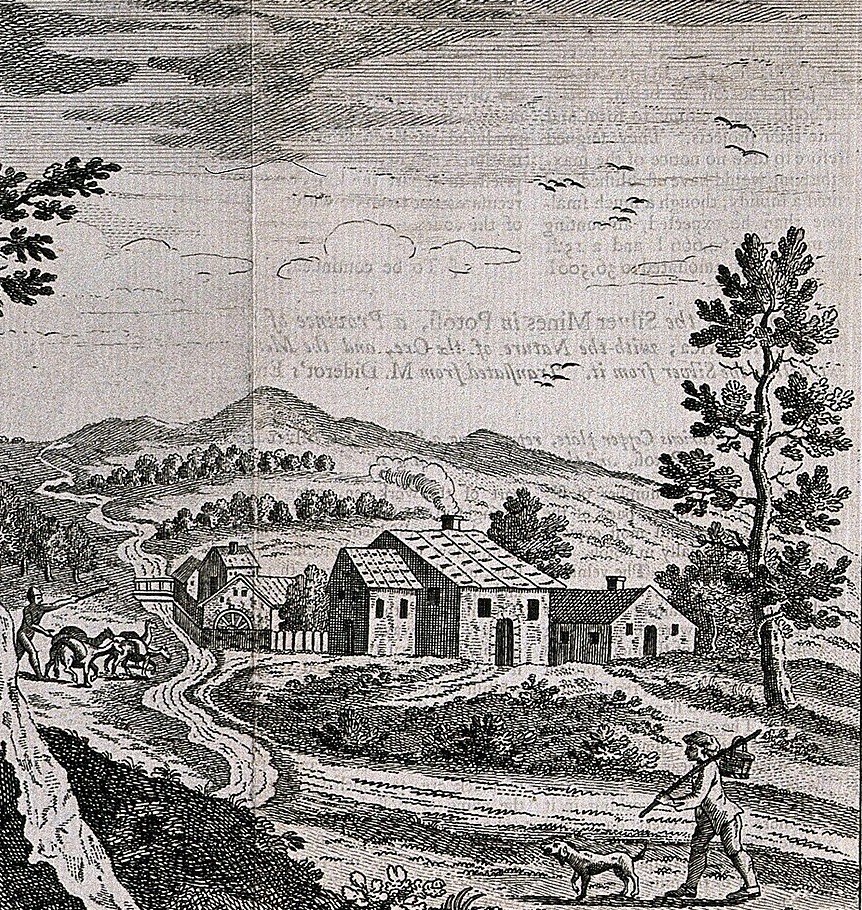
Potosi lies at the foot of the Cerro Rico, the Rich Mountain, in what is now Bolivia, at about 4,067 meters above sea level. Diego Huallpa, an Indigenous prospector, is traditionally credited with discovering the Cerro Rico in 1545, and the town was founded the same year. Wikipedia says the mountain was the major supply of silver for the Spanish Empire until Guanajuato in Mexico surpassed it in the 18th century. It reports an estimate that the Cerro Rico produced about 60 percent of all the silver mined in the world in the second half of the 16th century.
The wealth of Potosi rested on the mita, a Spanish system of forced labor based on an older Andean mit'a. Laborers came from an area of almost 200,000 square miles. About 13,000 men were conscripted each year, roughly one in seven adult Indigenous men. The mitayos faced harsh conditions, and carrying ore up from the mine to the surface in baskets, leather bags or cloth sacks was their task. Mercury was used to extract silver from poorer ores after the patio process was invented in 1554, and Wikipedia notes that mercury poisoning killed many people involved in refining.
Potosi grew into a very large city. An anonymous description from 1603 counted some 6,000 Spaniards and other Europeans, 5,000 Africans, many people of mixed heritage and at least 120,000 native Andeans. Wikipedia reports that the population eventually exceeded 200,000. The city gave Spanish the expression valer un Potosi, 'to be worth a Potosi', meaning to be of great value. UNESCO says that in the 16th century the site was regarded as the world's largest industrial complex, with silver extraction relying on hydraulic mills supplied by aqueducts and artificial lakes.
The city was also the site of the Spanish colonial silver mint, the Casa de la Moneda. UNESCO lists among its monuments the colonial town, the Church of San Lorenzo, patrician houses and the barrios mitayos, where the workers lived. During the Bolivian War of Independence, from 1809 to 1825, Potosi passed repeatedly between Royalist and Patriot control. The engraving on this page is a detail from a c. 1750 magazine print of a silver mine at Potosi. It is a contemporary European illustration, not a view of the mita at its height.
 Wikipedia: Potosi
 UNESCO World Heritage Centre: City of Potosi