 Go Back

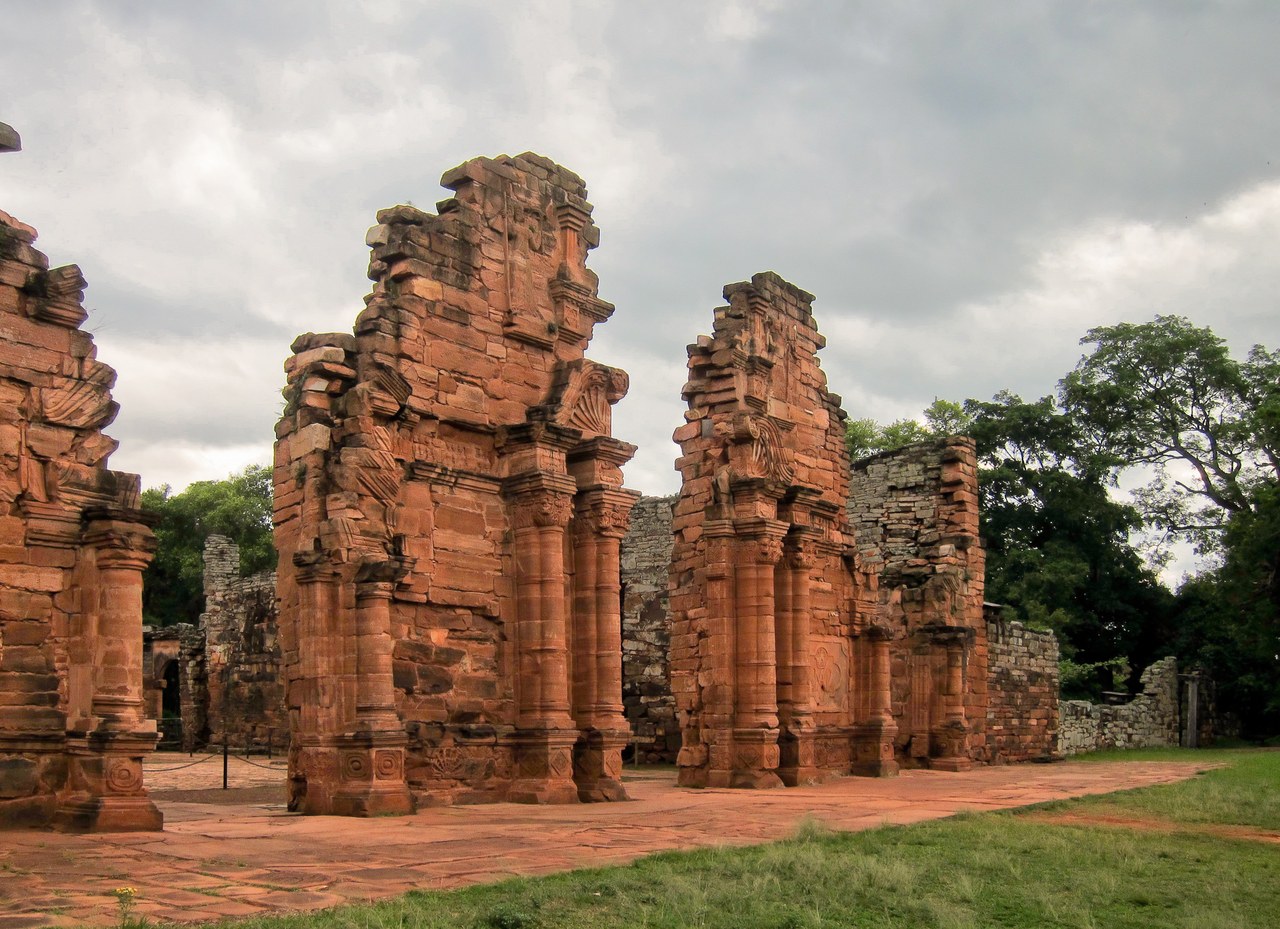
In the subtropical forests where Paraguay, Argentina, and Brazil now meet, Jesuit missionaries and the Guaraní people built one of the most unusual experiments in colonial history: a network of mission towns, called reductions, that sheltered Indigenous communities from slave raiders and settlers for a century and a half. The first missions were founded in 1609 with the permission of the Spanish crown, which hoped the Jesuits would convert and pacify the frontier peoples at little cost. The Guaraní, skilled farmers who grew maize, manioc, and yerba mate, came to the missions partly by choice, fleeing the slave raids of the bandeirantes, the brutal slave-hunting expeditions from Portuguese Brazil.
At their height in the early eighteenth century, thirty missions housed over one hundred thousand Guaraní. Each reduction was laid out around a vast plaza with a stone church, workshops, a college, and rows of family houses. The Jesuits governed in partnership with Guaraní chiefs, organizing communal agriculture, cattle ranches, and craft industries that produced everything from textiles to printed books. The missions became famous for their music: European instruments and polyphonic choral music took root, and Guaraní musicians composed and performed baroque works, a fusion that produced one of the most remarkable musical traditions of the colonial world.
The reductions lived under constant threat. Bandeirante raids in the 1620s-1630s destroyed missions and carried off thousands of captives, forcing the Jesuits to relocate entire populations downriver. The crown then took the unusual step of arming the Guaraní, and mission militias defeated the bandeirantes in battle in 1641, securing the region. For generations the missions prospered, but they faced growing hostility from Spanish settlers and officials who resented Jesuit control of Indigenous labor and suspected the order of building a state within the state.
The end came with the suppression of the Jesuits. In 1750 Spain and Portugal signed the Treaty of Madrid, redrawing borders and ordering seven missions east of the Uruguay River handed to Portugal, provoking the Guaraní War of 1754-1756 when the mission peoples refused to abandon their homes. Then in 1767 King Charles III expelled the Jesuits from all Spanish territories. Without their protectors, the missions declined: administrators looted them, residents drifted away, and the towns were abandoned to the forest. The ruins of San Ignacio Miní and Trinidad, now UNESCO World Heritage sites, preserve the grandeur of this vanished world.
 Wikipedia: Jesuit missions among the Guaraní
 Encyclopedia.com: Reductions of Paraguay
 Catholic Encyclopedia (New Advent): Reductions of Paraguay