 Go Back

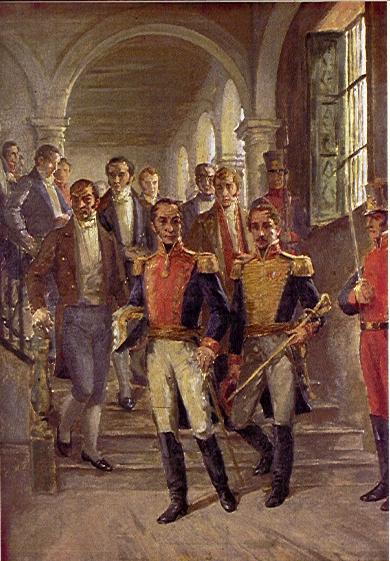
The Spanish-American Wars of Independence. The Spanish-American Wars of Independence had their harbinger in the Andes: on November 4, 1780, Tupac Amaru II - a kuraka of royal Inca blood - rose against the corregidor Arriaga, claiming to act under orders from the Spanish crown, and days later decreed the abolition of slavery for Black people, the first such decree in Spanish America, before his rebellion was crushed. The wars proper began with a collapse at the center: when Napoleon seized Spain and the Central Junta dissolved in January 1810, new juntas appeared across Spanish America, from Caracas on April 19 onward. In Mexico the revolt took the form of rebellion under Miguel Hidalgo, captured and executed in 1811, though resistance outlived him. These wars matter because they broke three centuries of Spanish rule and made a dozen nations.
The wars were won by two great converging campaigns. From the south, Jose de San Martin raised the Army of the Andes in Cuyo, led the audacious Crossing of the Andes into Chile, and triumphed at Chacabuco and Maipu, becoming the Liberator of Argentina, Chile, and Peru. From the north, Simon Bolivar freed Venezuela and New Granada, forming Gran Colombia. When the two liberators met behind closed doors at the Guayaquil conference on July 26-27, 1822, San Martin withdrew from the scene and Bolivar took over the task of fully liberating Peru. The end came high in the Andes: on December 9, 1824, at the Battle of Ayacucho, Bolivar's lieutenant Antonio Jose de Sucre defeated the royalist army, and Viceroy Jose de la Serna, wounded, surrendered - while Sucre's campaign continued through 1825 in Upper Peru. Spain's continental empire was finished.
 Britannica: Wars of independence
 Humanities LibreTexts: 4.1.1: Independence from Spanish rule in South America
 Smarthistory: Independence from Spanish rule in South America
 UNESCO: Dossier of documents related to the revolution of May 25, 1809 and the