 Go Back

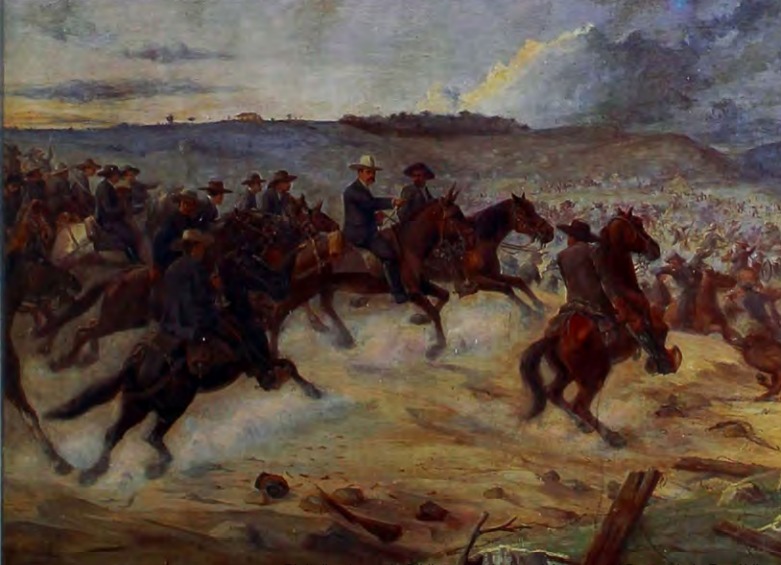
The Thousand Days' War, which ravaged Colombia from 1899 to 1902, was the culmination of a century of conflict between Liberals and Conservatives. Under the constitution of 1886, written during Rafael Nunez's Regeneration, Colombia had become a highly centralized, church-allied republic in which the Conservative Party monopolized power and excluded the Liberals from office. The Liberals, strong among merchants, artisans, and coffee smallholders, chafed under discrimination, and when a crash in coffee prices ruined the economy in the late 1890s, revolution became their answer.
The war began in October 1899 with Liberal uprisings in the coffee regions and along the Magdalena River. At first the rebels triumphed: in December their army won the battle of Peralonso, fought across a bridge in a two-day slaughter. The Liberal forces under Rafael Uribe Uribe then gambled on capturing the capital, but at Palonegro, near Bucaramanga, in May 1900, the Conservative army destroyed them in the bloodiest battle of the war. After Palonegro the conflict dissolved into years of guerrilla warfare, raids, and reprisals that burned through the countryside while the central government, beset by debts and intrigue, drifted.
The human cost was staggering. Estimates commonly put the dead at around one hundred thousand or more, with disease and hunger adding to the battlefield losses. Property was destroyed, trade collapsed, and the paper money the government printed to pay for the war became worthless. The war also spread into Panama, then a Colombian province, where both sides fought for control of the railway and the isthmus while United States warships watched from offshore. In October 1902 Uribe Uribe surrendered at the Neerlandia farm, and the last rebels in Panama laid down their arms a month later aboard an American battleship.
Colombia emerged from the war ruined and diminished. Exhausted and bankrupt, the government could not resist the secession of Panama in 1903, engineered with American support, and the loss of the isthmus became the war's most bitter legacy. Under the Conservative president Rafael Reyes, who ruled from 1904, the country slowly rebuilt its finances and railways, and the defeated Liberals reorganized as a legal opposition. Uribe Uribe himself, the great Liberal war leader, was assassinated in Bogota in 1914. The hatreds and the party banners of the Thousand Days' War, however, still defined Colombian political life in 1924.
 Wikipedia - Thousand Days' War
 Enciclopedia Banrepcultural - Civil wars in Colombia during the 19th century
 1911 Encyclopaedia Britannica - Colombia (Wikisource)