 Go Back

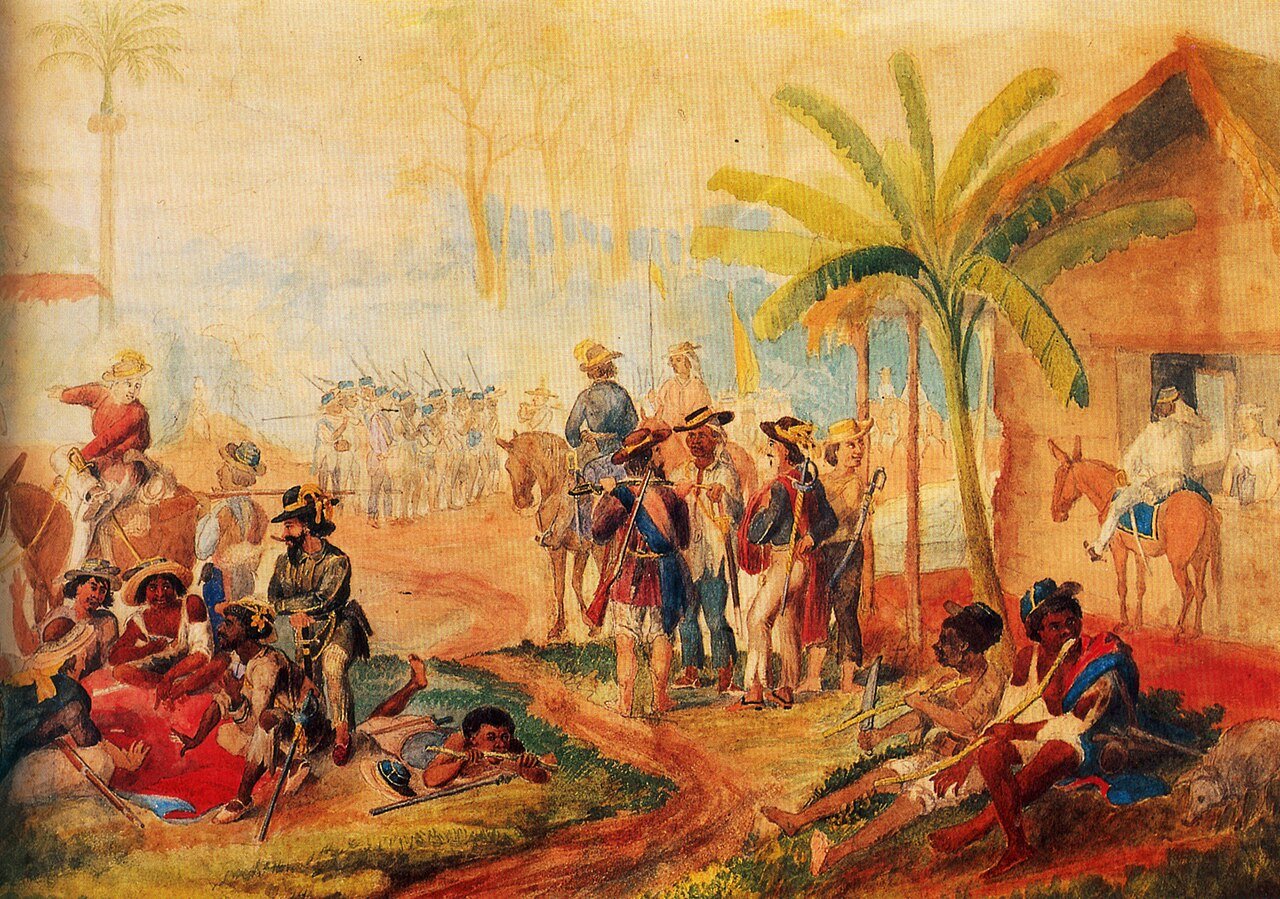
The Federal War. Venezuela in the 1850s was a nation exhausted by its own heroes: three decades of caudillo rule since independence had brought debts, dictatorship and the rule of a conservative oligarchy of Caracas planters, while the plainsmen and peasants who had fought the war remained landless. In 1859 the Liberal Party rose under the slogan that gave the war its name and its program: Federation - a republic of states against the centralism of Caracas - and, as the fighting radicalized, lands for the landless.
The war's driving force was Ezequiel Zamora, the chief of the plains, whose cavalry armies of llaneros made him for five years the terror of the oligarchy: he promised the land to those who worked it, and his horsemen carried federalism - and social revolution - through the interior until a stray bullet killed him at San Carlos in 1860. His brother Gabriel and then the guerrilla commander Juan Crisostomo Falcon carried on the war, which ground through sieges, massacres and devastation for four years and cost Venezuela, by the usual count, over a hundred thousand dead.
It ended in 1863 with the Treaty of Coche: the oligarchy yielded, Falcon entered Caracas as president, and the constitution of 1864 made Venezuela a federation of twenty sovereign states - the United States of Venezuela. The Liberals had won; and within a decade the victorious generals, Antonio Guzman Blanco above all, had rebuilt the centralized dictatorship in Liberal dress, while the land stayed where it had been.
The Federal War was the bloodiest of Venezuela's nineteenth-century wars and the defining trauma of its century: it destroyed the old conservative order, enthroned federalism in name, and taught the country's political class that the llanero masses could be raised - but never quite rewarded. Its memory fed the long line of strongmen that ran from Guzman Blanco to Cipriano Castro and Juan Vicente Gomez, who ruled Venezuela into the 1930s.
 Britannica: Venezuela - The Reigns of Guzman Blanco and Castro
Britannica: Antonio Guzman Blanco
Britannica: Venezuela