 Go Back

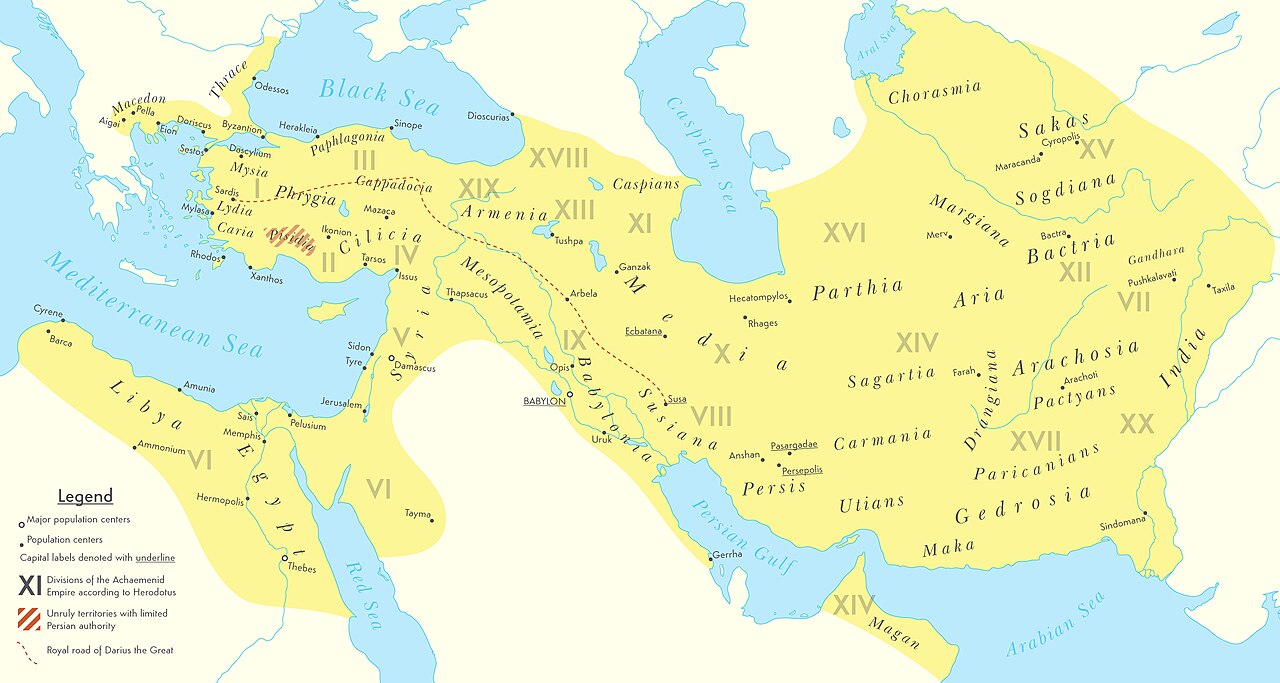
Achaemenid Empire. The Achaemenid Empire, founded by Cyrus the Great in 550 BCE, was the largest empire the world had yet seen: at its peak it covered some 5.5 million square kilometers, from the Balkans and Egypt in the west to the Indus Valley in the east, ruling tens of millions of people. Cyrus rose from Persis in southwestern Iran and in twenty years toppled three great powers - Media in 550, Croesus's Lydia in 547, and Babylon in 539 BCE, where the Cyrus Cylinder presented him as a restorer of order and where he freed the Jews from their Babylonian captivity, allowing them to rebuild the Temple in Jerusalem. His son Cambyses II added Egypt in 525 BCE after the battle of Pelusium.
The empire's true genius was organization. Darius the Great, who seized the throne in 522 BCE amid the confusion of a royal impostor he denounced on the great Behistun Inscription, divided the realm into satrapies governed by satraps, knit it together with the Royal Road and an organized postal service, and issued the gold daric coinage. Aramaic served as the administrative lingua franca alongside Old Persian, and the kings ruled from Susa and the ceremonial splendor of Persepolis. The Achaemenids are remembered for a multicultural policy and religious tolerance unusual for their age - Zoroastrianism was the dynasty's faith, but Jews, Egyptians, Greeks, and Babylonians worshipped their own gods - and their bureaucracy, civil service, and professional army and navy became models copied by later empires.
The western frontier proved the hardest. After the Ionian Revolt of 499 BCE, Darius's punitive expedition was defeated at Marathon in 490; his son Xerxes I invaded Greece with an enormous army in 480, forced the pass at Thermopylae, and sacked Athens, only to lose his fleet at Salamis and his army at Plataea and Mycale in 479, after which Persia lost its European territories. Thereafter the empire managed Greece by gold rather than armies - Persian funding helped Sparta finally defeat Athens in 404 BCE - and when Cyrus the Younger marched on his brother Artaxerxes II with the famous Ten Thousand Greek mercenaries in 401, his death at Cunaxa left the Greeks the long march home that Xenophon immortalized.
Artaxerxes II's 45-year reign brought stability and a building boom, but the Great Satraps' Revolt of 372-362 BCE showed the seams, and although Artaxerxes III reconquered Egypt in 343, the empire's two centuries were nearing their end. Between 336 and 330 BCE Alexander of Macedon conquered the whole empire, defeating the last king, Darius III, at Gaugamela in 331. Yet the Achaemenid template - provinces, roads, coinage, tolerance, a professional administration - passed almost intact to the Seleucids, was reclaimed by the Iranian Parthians and Sasanians, and still shapes how we imagine empire itself.
 Britannica: Achaemenid Empire
 World History Encyclopedia: Achaemenid Empire
 Humanities LibreTexts: 6.4: The Achaemenid Empire
 Encyclopaedia Iranica: ACHAEMENID DYNASTY ii. The empire